
This space is dedicated to thoughtful reflections and practical insights for families supporting gifted and twice-exceptional learners.
Here, we explore learning environments, literacy development, and growth-centered approaches designed to help gifted and twice-exceptional learners feel capable, confident, and supported.
New here?
If you’re exploring this space for the first time, our foundational post on multilevel learning offers a helpful place to begin.
👉 Why Multilevel Learning Works for Gifted and Twice-Exceptional Learners
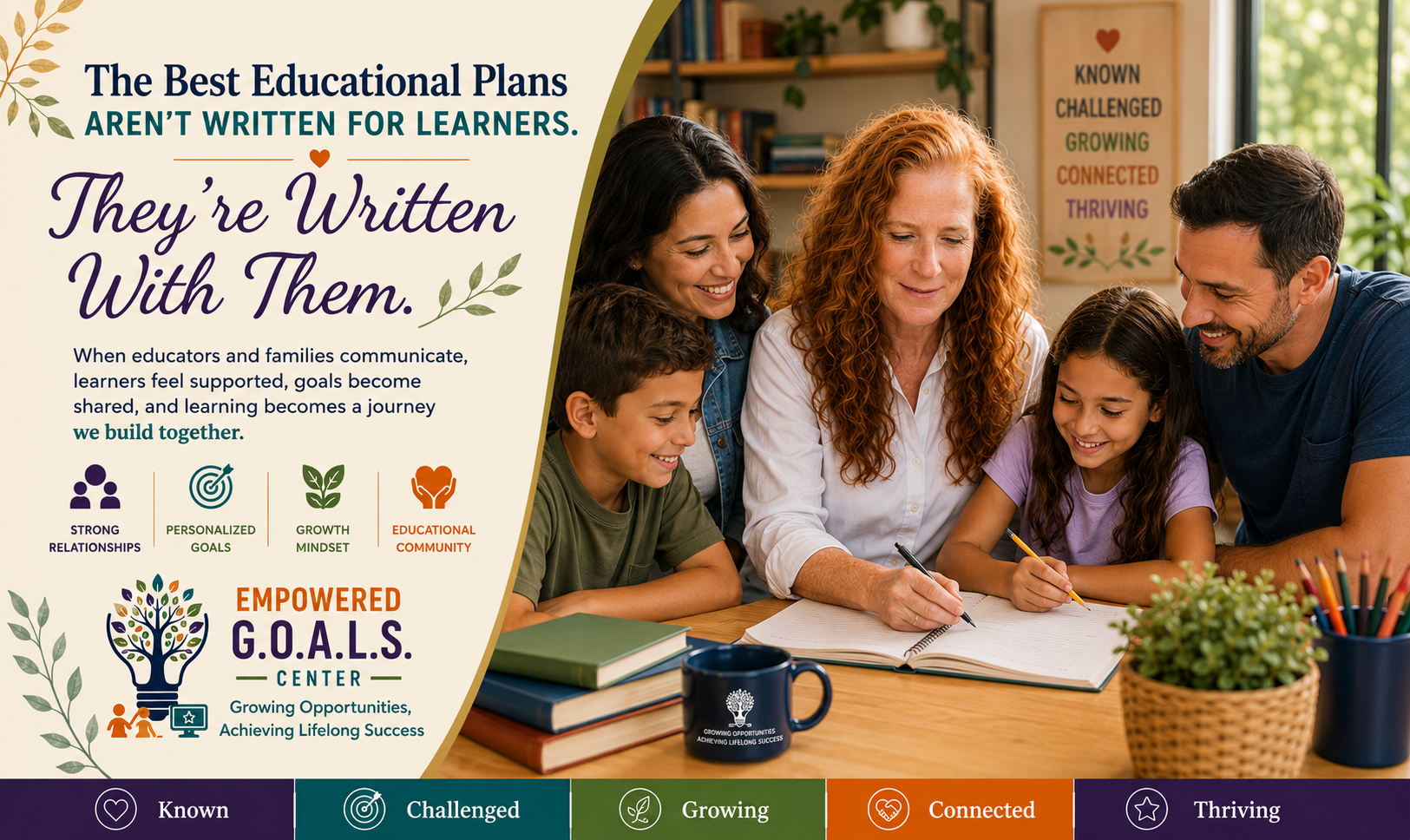
The Best Educational Plans Aren't Written for Learners. They're Written With Them.
The strongest educational plans begin with conversation. Discover why meaningful partnerships among learners, families, and educators create personalized goals, stronger relationships, and thriving educational communities.
One of the most meaningful questions an educator can ask isn't:
"How is this learner performing?"
It's:
"What does this learner need to grow?"
The answer rarely comes from a test score.
It comes from conversations.
It comes from relationships.
And it comes from building a genuine educational partnership between educators, learners, and families.
Every Learner Arrives with a Story
Long before a child walks into a classroom, they have already begun developing interests, strengths, challenges, dreams, and ways of understanding the world.
Parents have watched those moments unfold for years.
They know what excites their child.
They know what causes frustration.
They know what builds confidence—and what diminishes it.
Educators bring another important perspective.
They observe how learners interact with peers, approach challenges, solve problems, and respond to new opportunities.
Neither perspective is complete on its own.
Together, they create a fuller picture of the whole child.
Communication Builds Trust
When educators and families communicate regularly, something powerful happens.
Small concerns are addressed before they become larger ones.
Successes are celebrated together.
Goals become shared rather than separate.
Most importantly, learners begin to see that the important adults in their lives are working together—not independently.
That sense of consistency creates emotional safety.
And emotional safety creates room for learning.
Moving Beyond Report Cards
Traditional report cards rarely tell the entire story.
A grade cannot fully capture:
• Growing confidence
• Increased perseverance
• Stronger friendships
• Curiosity
• Leadership
• Creativity
• Resilience
• Problem-solving
These qualities matter.
In many ways, they are the foundation upon which lifelong learning is built.
That's why meaningful conversations between educators and families remain so important.
They allow us to celebrate growth that cannot be measured with numbers or letters.
Personalized Goals Begin with Listening
At Empowered G.O.A.L.S. Center, we believe educational goals should never be created in isolation.
Instead, they should emerge through thoughtful conversations that include three important voices:
The learner.
The family.
The educator.
Each brings valuable insight.
Learners often know what excites them, what challenges them, and what they hope to accomplish.
Families provide history, perspective, and dreams for the future.
Educators contribute experience, observation, and guidance.
When those perspectives come together, educational goals become deeply personal rather than simply procedural.
Learning becomes something we build together—not something we do to a child.
That's the heart of personalized education.
Building an Educational Community
One of the core beliefs that shapes Empowered G.O.A.L.S. Center is that education works best when it feels like a community.
Not a collection of separate people working independently.
A community.
In a strong educational community:
• Families are welcomed as partners.
• Learners feel heard and respected.
• Educators communicate openly and consistently.
• Everyone shares the same purpose: helping each learner continue growing.
That partnership creates something much bigger than academic success.
It creates belonging.
And children who know they belong become more willing to take risks, ask questions, persevere through challenges, and discover their own strengths.
Looking Ahead
Every learner deserves adults who believe in them.
Every family deserves to feel heard.
Every educator deserves the opportunity to build meaningful relationships with the learners they serve.
When we move beyond simply exchanging information and begin building authentic partnerships, education becomes something far more powerful.
It becomes a shared journey.
And perhaps that's one of the greatest gifts we can offer our children—not simply an education, but a community of people who believe in their potential and are committed to helping them grow.
About the Author
Karena Morrison is the founder of Empowered G.O.A.L.S. Center, a personalized microschool serving families in the Clearwater/Largo area. She is a Florida-certified educator in Exceptional Student Education (K–12) and Elementary Education (K–6), with endorsements in Reading and ESOL, and holds a master's degree in Curriculum & Instruction with a specialization in Gifted Studies. With more than 25 years of homeschooling experience, she believes the strongest educational communities are built through meaningful partnerships among learners, families, and educators.
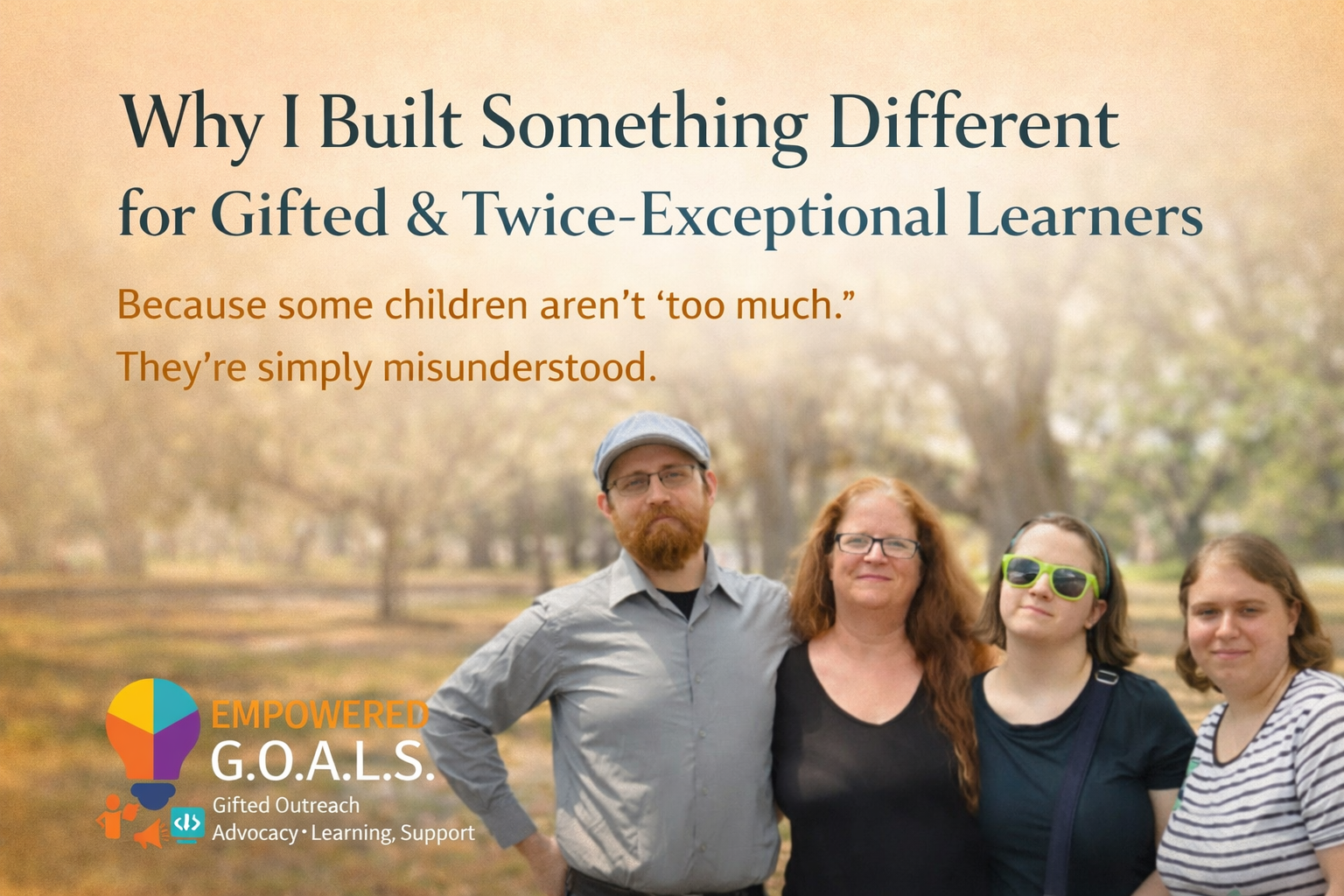
Why Gifted and Twice-Exceptional Learners Need a Different Kind of Education
Discover why gifted and twice-exceptional learners often struggle in traditional schools — and what personalized, learner-centered education offers instead.
I remember sitting in first and second grade, joyfully and enthusiastically raising my hand to reply to my teacher’s question posed to the entire class — and being told to put it down, or worse. I was mocked for my excitement to participate.
I was curious. Intense. Full of questions.
But I wasn’t identified as gifted.
Instead, I learned to shrink parts of myself to fit a traditional classroom that wasn’t designed for learners who think deeply, move quickly, or process differently.
I didn’t know it then, but I was one of many gifted learners who struggle not because they lack ability — but because the system isn’t built for asynchronous development.
Fortunately, I was blessed with a third-grade teacher who recognized the “look” of a defeated, yet gifted, learner. She saved me. She recognized that I had a gift that could be shared with my classmates. She sparked the joy of sharing my knowledge with others that has remained a deep passion of mine for over half a century.
Years later, I would see this pattern again in my own children.
When Gifted Learners Don’t “Look” Gifted
Many gifted and high-potential learners don’t fit the stereotype.
Some are sensitive.
Some are intense.
Some are creative and nonlinear.
Some are twice-exceptional — meaning they are gifted and also have learning differences, ADHD, autism spectrum traits, or other processing differences.
My son was one of them.
Brilliant in math and science, and a college level reading comprehension by second-grade.
Struggling in ways that confused educators.
“He’s so smart… but…”
That sentence follows many twice-exceptional families.
Gifted, but distracted.
Advanced, but inconsistent.
Twice-exceptional learners often fall through the cracks in traditional schools because their strengths mask their struggles — and their struggles mask their strengths.
Why Traditional Schools Often Miss Gifted and 2e Learners
Public and charter schools serve many families well.
But they are built around:
Age-based grouping
Standard pacing
Grade-level expectations
Uniform assessments
Gifted and twice-exceptional learners are often asynchronous — meaning their intellectual development may far exceed their emotional, executive functioning, or writing development.
When education is standardized, these learners can experience:
Chronic boredom
Underachievement
Behavioral mislabeling
Anxiety and perfectionism
Loss of motivation
I saw this not only as a parent, but later as a classroom teacher.
And I couldn’t ignore it.
I’ve written more about how this shows up in real classrooms here.
What Happens When the Environment Fits
For over 25 years, I homeschooled my children.
My son - gifted in math and sciences - needed an environment that supported his specific language challenge while understanding that he was way beyond his “peers” in reading and comprehension.
My oldest daughter — gifted in art and creative writing and on the spectrum — needed an environment that honored her originality.
My youngest — deeply creative — needed space to grow without having her imagination standardized away.
In a personalized, learner-centered environment:
Gifted learners move at their level.
Twice-exceptional learners receive support without shame.
Creativity is nurtured.
Mastery replaces busywork.
Confidence grows before performance.
The difference isn’t lower expectations.
It’s alignment.
Why I Built Empowered G.O.A.L.S.
After teaching in public and charter schools, I became deeply convinced:
Gifted and twice-exceptional learners need educational environments that are flexible, personalized, and mastery-based.
They need small communities where they are known.
They need opportunities to grow beyond “grade level” labels.
They need educators who understand both high potential and learning differences.
Empowered G.O.A.L.S. was built to support gifted, high-potential, and twice-exceptional learners through learner-centered education and advocacy in a small, personalized microschool environment. You can learn more about what that looks like here.
Because gifted children don’t need to be fixed.
They need to be understood.
And twice-exceptional learners don’t need to be reshaped.
They need environments that honor the whole child.
If You’re Searching for Support for a Gifted or Twice-Exceptional Child
If you’ve found yourself Googling:
“Why is my gifted child struggling?”
“Support for twice-exceptional learners”
“Alternative education for gifted children”
“Microschool for gifted learners”
You’re not alone.
There are other ways.
The first step isn’t “fixing” your child — it’s finding an environment that fits them.
If you’re beginning to explore different educational paths for your gifted or twice-exceptional child, I invite you to reach out through my contact page.