
This space is dedicated to thoughtful reflections and practical insights for families supporting gifted and twice-exceptional learners.
Here, we explore learning environments, literacy development, and growth-centered approaches designed to help gifted and twice-exceptional learners feel capable, confident, and supported.
New here?
If you’re exploring this space for the first time, our foundational post on multilevel learning offers a helpful place to begin.
👉 Why Multilevel Learning Works for Gifted and Twice-Exceptional Learners
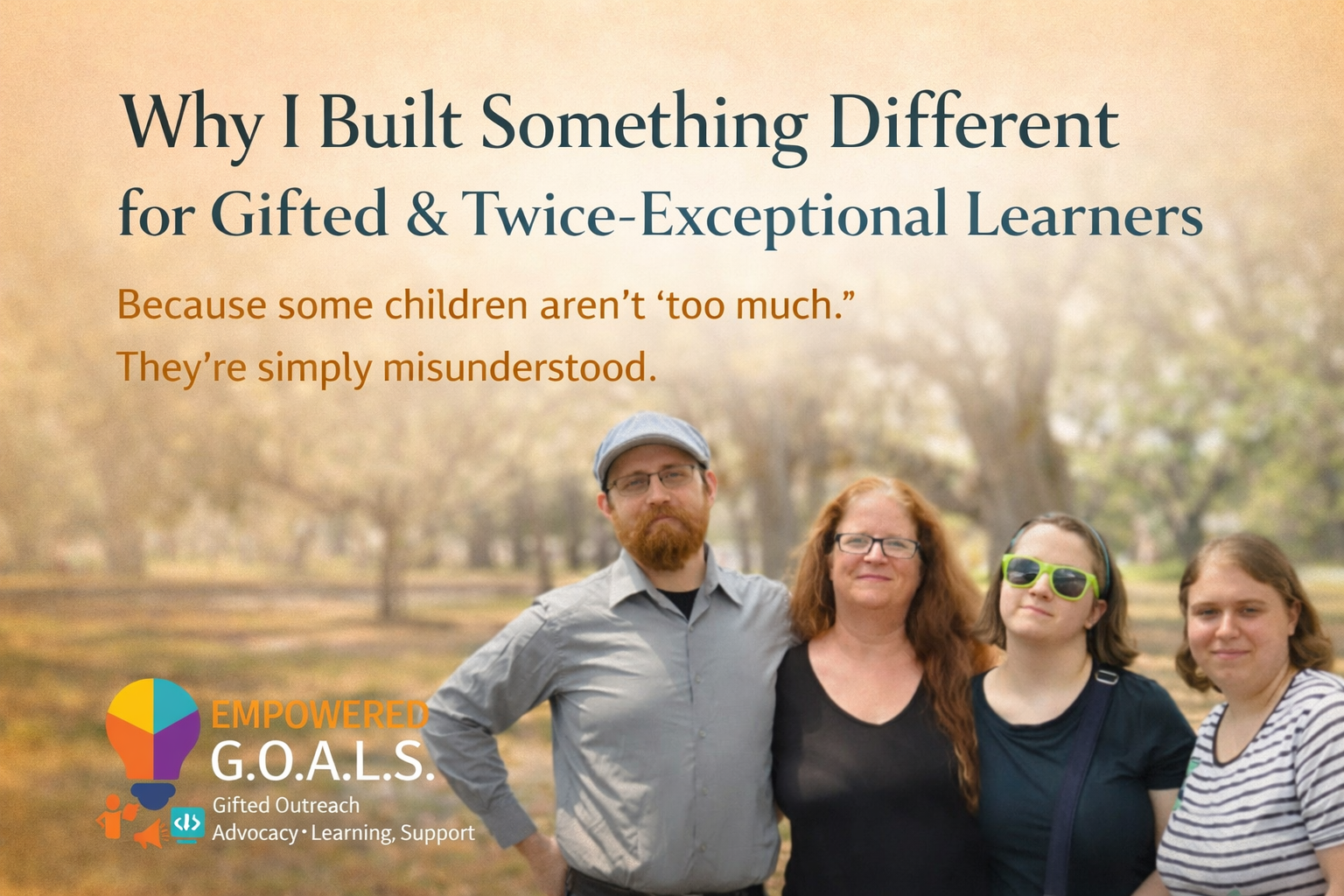
Why Gifted and Twice-Exceptional Learners Need a Different Kind of Education
Discover why gifted and twice-exceptional learners often struggle in traditional schools — and what personalized, learner-centered education offers instead.
I remember sitting in first and second grade, joyfully and enthusiastically raising my hand to reply to my teacher’s question posed to the entire class — and being told to put it down, or worse. I was mocked for my excitement to participate.
I was curious. Intense. Full of questions.
But I wasn’t identified as gifted.
Instead, I learned to shrink parts of myself to fit a traditional classroom that wasn’t designed for learners who think deeply, move quickly, or process differently.
I didn’t know it then, but I was one of many gifted learners who struggle not because they lack ability — but because the system isn’t built for asynchronous development.
Fortunately, I was blessed with a third-grade teacher who recognized the “look” of a defeated, yet gifted, learner. She saved me. She recognized that I had a gift that could be shared with my classmates. She sparked the joy of sharing my knowledge with others that has remained a deep passion of mine for over half a century.
Years later, I would see this pattern again in my own children.
When Gifted Learners Don’t “Look” Gifted
Many gifted and high-potential learners don’t fit the stereotype.
Some are sensitive.
Some are intense.
Some are creative and nonlinear.
Some are twice-exceptional — meaning they are gifted and also have learning differences, ADHD, autism spectrum traits, or other processing differences.
My son was one of them.
Brilliant in math and science, and a college level reading comprehension by second-grade.
Struggling in ways that confused educators.
“He’s so smart… but…”
That sentence follows many twice-exceptional families.
Gifted, but distracted.
Advanced, but inconsistent.
Twice-exceptional learners often fall through the cracks in traditional schools because their strengths mask their struggles — and their struggles mask their strengths.
Why Traditional Schools Often Miss Gifted and 2e Learners
Public and charter schools serve many families well.
But they are built around:
Age-based grouping
Standard pacing
Grade-level expectations
Uniform assessments
Gifted and twice-exceptional learners are often asynchronous — meaning their intellectual development may far exceed their emotional, executive functioning, or writing development.
When education is standardized, these learners can experience:
Chronic boredom
Underachievement
Behavioral mislabeling
Anxiety and perfectionism
Loss of motivation
I saw this not only as a parent, but later as a classroom teacher.
And I couldn’t ignore it.
I’ve written more about how this shows up in real classrooms here.
What Happens When the Environment Fits
For over 25 years, I homeschooled my children.
My son - gifted in math and sciences - needed an environment that supported his specific language challenge while understanding that he was way beyond his “peers” in reading and comprehension.
My oldest daughter — gifted in art and creative writing and on the spectrum — needed an environment that honored her originality.
My youngest — deeply creative — needed space to grow without having her imagination standardized away.
In a personalized, learner-centered environment:
Gifted learners move at their level.
Twice-exceptional learners receive support without shame.
Creativity is nurtured.
Mastery replaces busywork.
Confidence grows before performance.
The difference isn’t lower expectations.
It’s alignment.
Why I Built Empowered G.O.A.L.S.
After teaching in public and charter schools, I became deeply convinced:
Gifted and twice-exceptional learners need educational environments that are flexible, personalized, and mastery-based.
They need small communities where they are known.
They need opportunities to grow beyond “grade level” labels.
They need educators who understand both high potential and learning differences.
Empowered G.O.A.L.S. was built to support gifted, high-potential, and twice-exceptional learners through learner-centered education and advocacy in a small, personalized microschool environment. You can learn more about what that looks like here.
Because gifted children don’t need to be fixed.
They need to be understood.
And twice-exceptional learners don’t need to be reshaped.
They need environments that honor the whole child.
If You’re Searching for Support for a Gifted or Twice-Exceptional Child
If you’ve found yourself Googling:
“Why is my gifted child struggling?”
“Support for twice-exceptional learners”
“Alternative education for gifted children”
“Microschool for gifted learners”
You’re not alone.
There are other ways.
The first step isn’t “fixing” your child — it’s finding an environment that fits them.
If you’re beginning to explore different educational paths for your gifted or twice-exceptional child, I invite you to reach out through my contact page.
Why Gifted Learners Struggle in Grade-Level Classrooms
Many gifted learners struggle in school not because of ability, but because the learning environment doesn’t match how they think. This post explores why grade-level classrooms can feel limiting — and what gifted learners need instead.
Blog Series
Families of gifted learners often find themselves confused and frustrated by a troubling contradiction.
Their child is bright, curious, and capable — yet school feels like a constant struggle.
Grades may not reflect ability. Motivation may fluctuate. Confidence may quietly erode. And parents are left wondering: If my child is gifted, why does learning feel so hard?
For many gifted learners, the challenge isn’t intelligence.
It’s fit.
When Ability and Environment Don’t Align
Traditional classrooms are designed around grade-level expectations, standardized pacing, and whole-group instruction. While this structure works for some learners, it can unintentionally create barriers for gifted children whose learning profiles don’t follow a straight line.
Gifted learners often:
Think more deeply or abstractly than peers
Learn quickly in some areas and unevenly in others
Crave meaning, complexity, and autonomy
Become disengaged when learning feels repetitive or disconnected
When instruction moves too slowly, gifted learners may appear bored or inattentive.
When it moves too rigidly, they may feel boxed in or misunderstood.
Over time, this mismatch can look like underachievement — even though the learner’s potential hasn’t changed.
The Emotional Weight Gifted Learners Carry
One of the most overlooked aspects of giftedness is its emotional impact.
Many gifted learners are highly aware of expectations — both external and internal. When school becomes a place where they feel out of sync, they may begin to internalize the struggle.
You might hear things like:
“I’m bad at school.”
“I don’t like reading anymore.”
“I’m just not good at this.”
These aren’t signs of laziness or defiance. They’re signals that the learning environment isn’t supporting how the child learns best.
Gifted learners often need flexibility, depth, and relational safety — not more pressure.
Why Grade-Level Classrooms Can Feel Limiting
Grade-level classrooms are built on the assumption that learners of the same age benefit from the same pacing and instruction. But gifted learners frequently operate outside that assumption.
They may be:
Ready to move ahead conceptually but still developing executive skills
Advanced in reasoning but sensitive to failure
Capable of complex thinking yet disengaged by surface-level tasks
When learning is tied tightly to grade-based benchmarks, gifted learners can feel held back in some areas and overwhelmed in others — all at once.
This doesn’t mean grade-level classrooms are “wrong.”
It means they aren’t always the best fit for every learner.
Reframing the Struggle
When gifted learners struggle, it’s important to shift the question from:
“What’s wrong with my child?”
to
“What does my child need?”
Many families find that learning environments offering more flexibility — such as multilevel or small-group settings — allow gifted learners to re-engage with curiosity and confidence.
In these spaces, learners can:
Move at a pace that matches their readiness
Explore ideas in greater depth
Receive support without stigma
Be known as whole people, not just data points
This shift often brings relief — not just academically, but emotionally.
A Bigger Conversation
This post is part of a broader conversation about how learning environments impact gifted and twice-exceptional learners.
In a previous post, I shared why multilevel learning environments often provide a more supportive, human-centered approach for gifted and 2e learners. Understanding why traditional classrooms can feel challenging is the first step toward imagining what’s possible when learning is better aligned.
If you’re noticing your learner struggling despite clear ability, you’re not alone — and your instincts matter.
More reflections are coming as we continue exploring thoughtful, relationship-centered approaches to supporting gifted and twice-exceptional learners.
A Thoughtful Approach to Supporting Gifted & Twice-Exceptional Learners
Families of gifted and twice-exceptional learners often sense that traditional schooling doesn’t fully fit their child’s needs. This series explores thoughtful, relationship-centered approaches that honor how gifted and 2e learners grow, learn, and thrive.
Series Introduction
Families of gifted and twice-exceptional learners often find themselves asking the same questions again and again:
Why does school feel harder than it should?
Why is my child capable, curious, and bright — yet frustrated or disengaged?
Why does support so often feel like it comes after struggle instead of before?
This space was created to explore those questions with care.
Here, we’ll be sharing reflections, insights, and practical ideas around learning environments that better support gifted and twice-exceptional learners — academically, emotionally, and developmentally. Our focus is on approaches that honor curiosity, flexible pacing, and confidence-building, rather than one-size-fits-all solutions.
You’ll find conversations about multilevel learning, small-group instruction, literacy development, perfectionism, and what it means to create learning spaces where learners feel capable and supported.
This blog will continue to grow over time, with contributions from educators, learning guides, and advocates who work closely with gifted and twice-exceptional learners.
If you’re navigating these questions as a parent or caregiver, you’re in the right place. More conversations are coming — thoughtfully, intentionally, and with learners at the center.
New reflections are added regularly to our blog as our work and conversations evolve.