
This space is dedicated to thoughtful reflections and practical insights for families supporting gifted and twice-exceptional learners.
Here, we explore learning environments, literacy development, and growth-centered approaches designed to help gifted and twice-exceptional learners feel capable, confident, and supported.
New here?
If you’re exploring this space for the first time, our foundational post on multilevel learning offers a helpful place to begin.
👉 Why Multilevel Learning Works for Gifted and Twice-Exceptional Learners
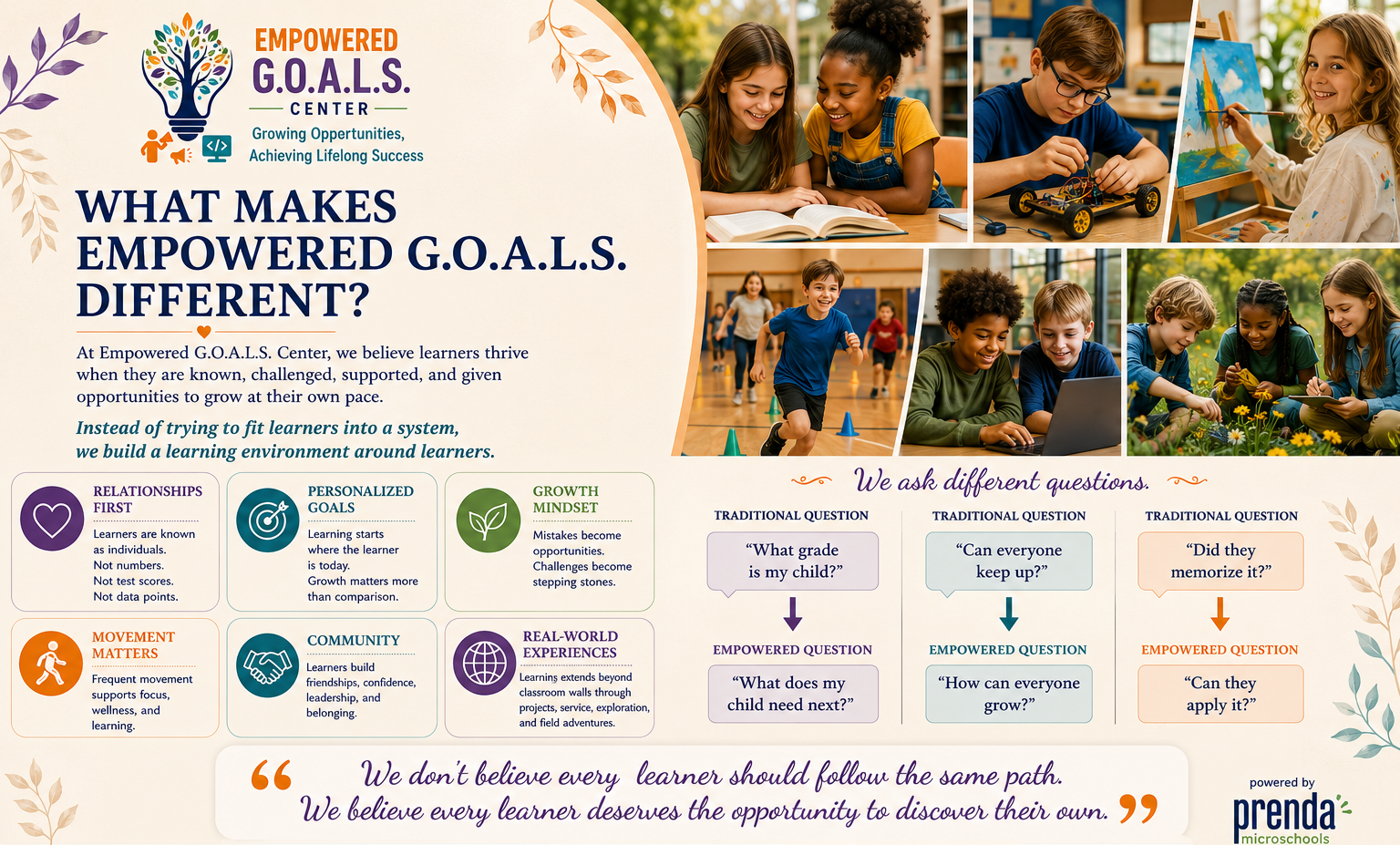
Children Don't All Learn the Same Way… Why Should They All Learn in the Same Place?
Children don't all learn the same way, so why should they all learn in the same place? Explore how personalized education, microschools, and learner-centered environments help gifted, high-potential, and twice-exceptional children thrive. Discover Empowered G.O.A.L.S. Center, serving families in the Clearwater and Largo, Florida area.
For generations, we've accepted the idea that children should learn together in the same place, following the same schedule, moving through the same curriculum at roughly the same pace.
For many learners, that model has worked well.
But as we've learned more about child development, neuroscience, giftedness, learning differences, and personalized education, an important question has emerged:
If children don't all learn the same way, why should they all learn in the same place?
The question isn't meant to diminish traditional schools. Every educational setting serves an important purpose, and incredible educators are making a difference every day.
Rather, it's an invitation to recognize something we know to be true:
Children are wonderfully unique.
Some learners thrive in a large classroom filled with energy and activity.
Others flourish in smaller learning communities where they are deeply known.
Some learn best through discussion.
Others need time to observe before they share their thinking.
Some discover their strengths through books.
Others discover them while building, creating, designing, exploring nature, or solving real-world problems.
None of these approaches are better than the others.
They're simply different.
Every Child Deserves an Environment Where They Can Flourish
As educators and parents, we often focus on how children learn.
Visual learners.
Hands-on learners.
Independent learners.
Collaborative learners.
Those differences matter.
But there's another question that's equally important:
Where does this child learn best?
The environment itself shapes learning.
A child who struggles in one setting may thrive in another.
A learner who seems disengaged may simply need more opportunities to move, create, ask questions, or work alongside peers who share similar interests.
Sometimes the environment—not the learner—is what needs to change.
Learning Is More Than Completing Assignments
Education is about much more than checking off standards or finishing worksheets.
Children are learning how to think.
How to collaborate.
How to solve problems.
How to persevere through challenges.
How to communicate ideas with confidence.
How to discover who they are.
The most meaningful learning often happens when children are actively engaged—asking questions, investigating ideas, creating projects, and connecting what they're learning to the world around them.
Those experiences don't replace academics.
They make academics meaningful.
There Isn't One Right Path
Families today have more educational choices than ever before.
Traditional public schools.
Charter schools.
Private schools.
Homeschooling.
Microschools.
Hybrid learning programs.
Each offers unique strengths because every child—and every family—is different.
The goal isn't to convince every family to choose the same path.
The goal is to help every family find the environment where their child can grow with confidence, curiosity, and joy.
Building Learning Communities
One of the things that excites me most about microschools is the opportunity to create learning communities where every child is truly known.
Small groups allow educators to recognize individual strengths, celebrate growth, and build meaningful relationships with learners and their families.
Children aren't simply another face in the classroom.
They become active participants in a community that values their ideas, encourages their curiosity, and supports their growth.
When learners feel known, they become more willing to take risks.
When they feel safe, they become more willing to ask questions.
When they feel valued, they begin to see themselves as capable.
And confidence has a remarkable way of opening doors to learning.
Looking Ahead
Education continues to evolve because our understanding of children continues to grow.
That's something worth celebrating.
My hope is that families feel empowered to explore the educational options available to them—not because one model is better than another, but because every child deserves an environment where they can flourish.
Children don't all learn the same way.
Perhaps they don't all need to learn in the same place, either.
And maybe that's one of the most exciting opportunities in education today.
About the Author
Karena Morrison is the founder of Empowered G.O.A.L.S. Center, a personalized microschool serving families in the Clearwater/Largo area. A Florida-certified educator with a master's degree in Gifted Studies, she has more than 25 years of homeschooling experience and is passionate about helping gifted, high-potential, and twice-exceptional learners discover confidence, curiosity, and a lifelong love of learning.
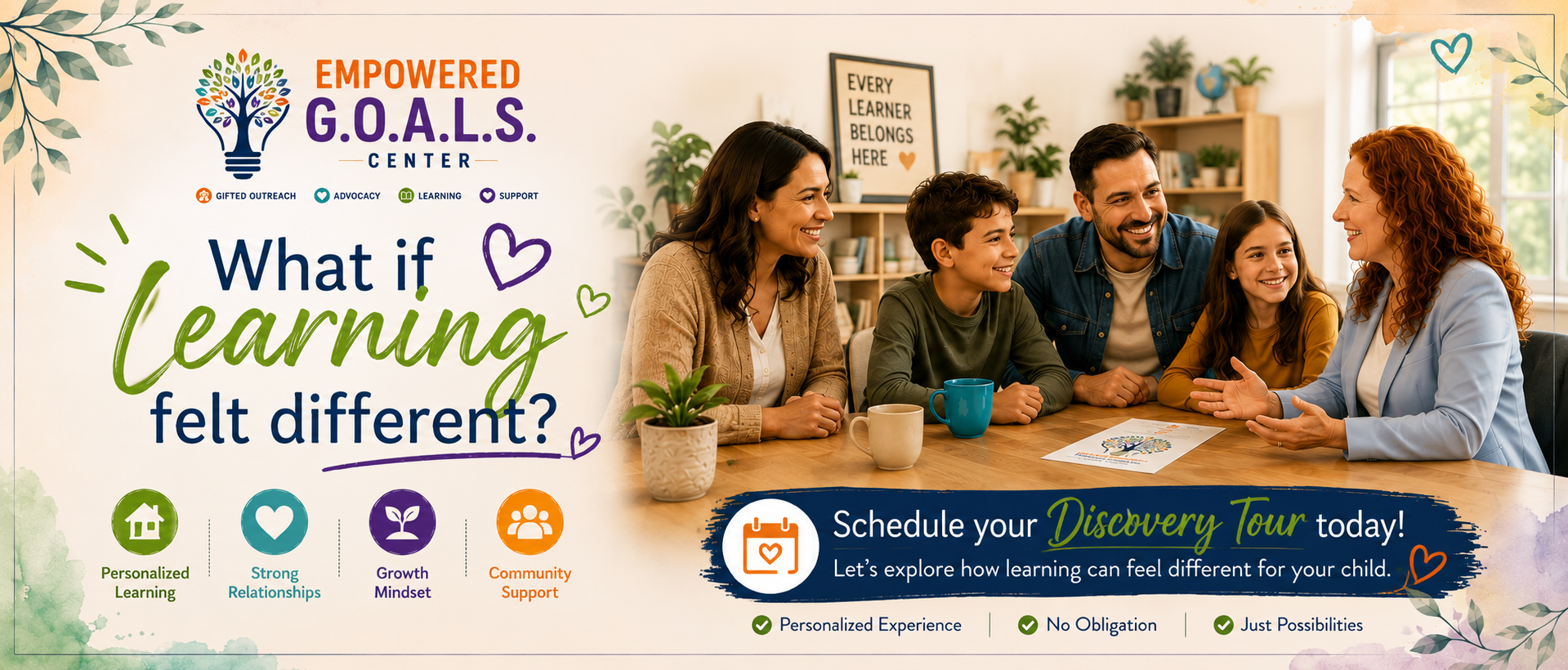
You Don’t Have to Do Homeschooling Alone
Homeschooling offers flexibility and freedom—but even strong, curious learners can hit roadblocks with reading, writing, or confidence. Empowered Hybrid was created to support homeschool families who want thoughtful, relationship-centered project-based instruction that meets learners where they are and helps them grow without pressure.
Homeschooling families often share a common story.
They didn't choose homeschooling because it was easy.
They chose it because it felt right for their learner.
Some were seeking flexibility.
Some were responding to burnout, anxiety, or unmet needs.
Some simply knew their child learned differently—and wanted an educational path that honored who they are.
After more than 25 years as a homeschooling parent, educator, and advocate for gifted and twice-exceptional learners, one truth has remained constant:
Homeschooling doesn't have to be a solo journey.
When You’re Doing Everything Right — and Still Wondering
Homeschooling parents invest incredible time, energy, and heart into their children's education.
They carefully select curriculum.
They adjust pacing.
They follow interests.
They celebrate strengths while supporting challenges.
And even then, questions naturally arise.
Am I providing enough opportunities for collaboration?
How can my child build friendships with other learners?
Would project-based learning help deepen their understanding?
How can I balance teaching at home while also meeting all of life's responsibilities?
These questions aren't signs that homeschooling isn't working.
They're signs of thoughtful parents who want the very best for their children.
Homeschooling Was Never Meant to Be a Solo Journey
One of the biggest misconceptions about homeschooling is that parents must do everything themselves.
In reality, many successful homeschooling families build a learning community around their children.
They seek opportunities for collaboration, enrichment, mentorship, field experiences, and friendships that complement learning at home.
Support doesn't replace homeschooling.
A Partnership Designed for Homeschool Families
That's why I created Empowered Pathways, our hybrid homeschool program at Empowered G.O.A.L.S. Center.
Families remain in charge of their learner's core academics at home while we partner together to provide meaningful opportunities for collaboration, creativity, and real-world learning.
Learners participate in:
Daily Connect community meetings
Collaborative Science and Social Studies experiences
Hands-on Create projects
Project-based learning
Meaningful peer interactions in small groups
Meanwhile, families continue guiding Reading and Math at home using the curriculum and pace that best meets their learner's needs.
It's homeschooling—with the added benefit of a supportive learning community.
Learning Is About More Than Academics
Children grow in many ways.
They develop confidence through collaboration.
Communication through shared experiences.
Leadership through meaningful responsibilities.
Creativity through authentic projects.
Friendships through spending time with peers who enjoy learning together.
These experiences are difficult to recreate alone, but they flourish within a small learning community where every learner is known and valued.
A Community That Grows Together
At Empowered G.O.A.L.S. Center, we believe children learn best when families and educators work together.
Our hybrid program isn't designed to replace homeschooling.
It's designed to support it.
Together, we create an environment where learners can continue growing academically while also developing confidence, curiosity, creativity, and meaningful connections.
An Invitation
If you're homeschooling and looking for opportunities to enrich your child's educational journey while remaining at the center of their learning, I'd love to connect with you.
Whether you're exploring hybrid education for the first time or simply looking for a community that shares your values, you're always welcome to learn more about Empowered Pathways at Empowered G.O.A.L.S. Center.
Because homeschooling doesn't have to happen alone—and sometimes the greatest growth happens when families learn together.