
This space is dedicated to thoughtful reflections and practical insights for families supporting gifted and twice-exceptional learners.
Here, we explore learning environments, literacy development, and growth-centered approaches designed to help gifted and twice-exceptional learners feel capable, confident, and supported.
New here?
If you’re exploring this space for the first time, our foundational post on multilevel learning offers a helpful place to begin.
👉 Why Multilevel Learning Works for Gifted and Twice-Exceptional Learners
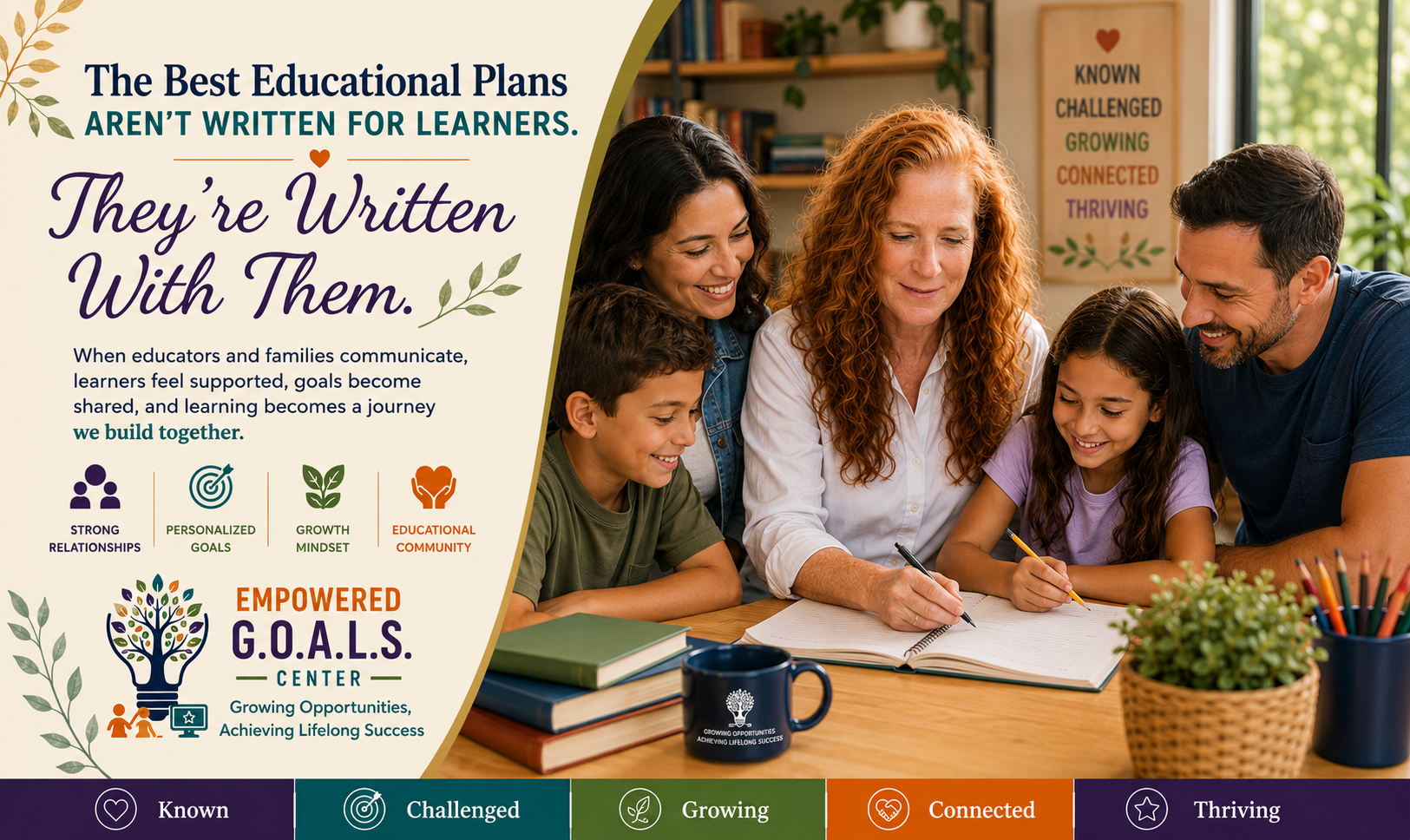
The Best Educational Plans Aren't Written for Learners. They're Written With Them.
The strongest educational plans begin with conversation. Discover why meaningful partnerships among learners, families, and educators create personalized goals, stronger relationships, and thriving educational communities.
One of the most meaningful questions an educator can ask isn't:
"How is this learner performing?"
It's:
"What does this learner need to grow?"
The answer rarely comes from a test score.
It comes from conversations.
It comes from relationships.
And it comes from building a genuine educational partnership between educators, learners, and families.
Every Learner Arrives with a Story
Long before a child walks into a classroom, they have already begun developing interests, strengths, challenges, dreams, and ways of understanding the world.
Parents have watched those moments unfold for years.
They know what excites their child.
They know what causes frustration.
They know what builds confidence—and what diminishes it.
Educators bring another important perspective.
They observe how learners interact with peers, approach challenges, solve problems, and respond to new opportunities.
Neither perspective is complete on its own.
Together, they create a fuller picture of the whole child.
Communication Builds Trust
When educators and families communicate regularly, something powerful happens.
Small concerns are addressed before they become larger ones.
Successes are celebrated together.
Goals become shared rather than separate.
Most importantly, learners begin to see that the important adults in their lives are working together—not independently.
That sense of consistency creates emotional safety.
And emotional safety creates room for learning.
Moving Beyond Report Cards
Traditional report cards rarely tell the entire story.
A grade cannot fully capture:
• Growing confidence
• Increased perseverance
• Stronger friendships
• Curiosity
• Leadership
• Creativity
• Resilience
• Problem-solving
These qualities matter.
In many ways, they are the foundation upon which lifelong learning is built.
That's why meaningful conversations between educators and families remain so important.
They allow us to celebrate growth that cannot be measured with numbers or letters.
Personalized Goals Begin with Listening
At Empowered G.O.A.L.S. Center, we believe educational goals should never be created in isolation.
Instead, they should emerge through thoughtful conversations that include three important voices:
The learner.
The family.
The educator.
Each brings valuable insight.
Learners often know what excites them, what challenges them, and what they hope to accomplish.
Families provide history, perspective, and dreams for the future.
Educators contribute experience, observation, and guidance.
When those perspectives come together, educational goals become deeply personal rather than simply procedural.
Learning becomes something we build together—not something we do to a child.
That's the heart of personalized education.
Building an Educational Community
One of the core beliefs that shapes Empowered G.O.A.L.S. Center is that education works best when it feels like a community.
Not a collection of separate people working independently.
A community.
In a strong educational community:
• Families are welcomed as partners.
• Learners feel heard and respected.
• Educators communicate openly and consistently.
• Everyone shares the same purpose: helping each learner continue growing.
That partnership creates something much bigger than academic success.
It creates belonging.
And children who know they belong become more willing to take risks, ask questions, persevere through challenges, and discover their own strengths.
Looking Ahead
Every learner deserves adults who believe in them.
Every family deserves to feel heard.
Every educator deserves the opportunity to build meaningful relationships with the learners they serve.
When we move beyond simply exchanging information and begin building authentic partnerships, education becomes something far more powerful.
It becomes a shared journey.
And perhaps that's one of the greatest gifts we can offer our children—not simply an education, but a community of people who believe in their potential and are committed to helping them grow.
About the Author
Karena Morrison is the founder of Empowered G.O.A.L.S. Center, a personalized microschool serving families in the Clearwater/Largo area. She is a Florida-certified educator in Exceptional Student Education (K–12) and Elementary Education (K–6), with endorsements in Reading and ESOL, and holds a master's degree in Curriculum & Instruction with a specialization in Gifted Studies. With more than 25 years of homeschooling experience, she believes the strongest educational communities are built through meaningful partnerships among learners, families, and educators.
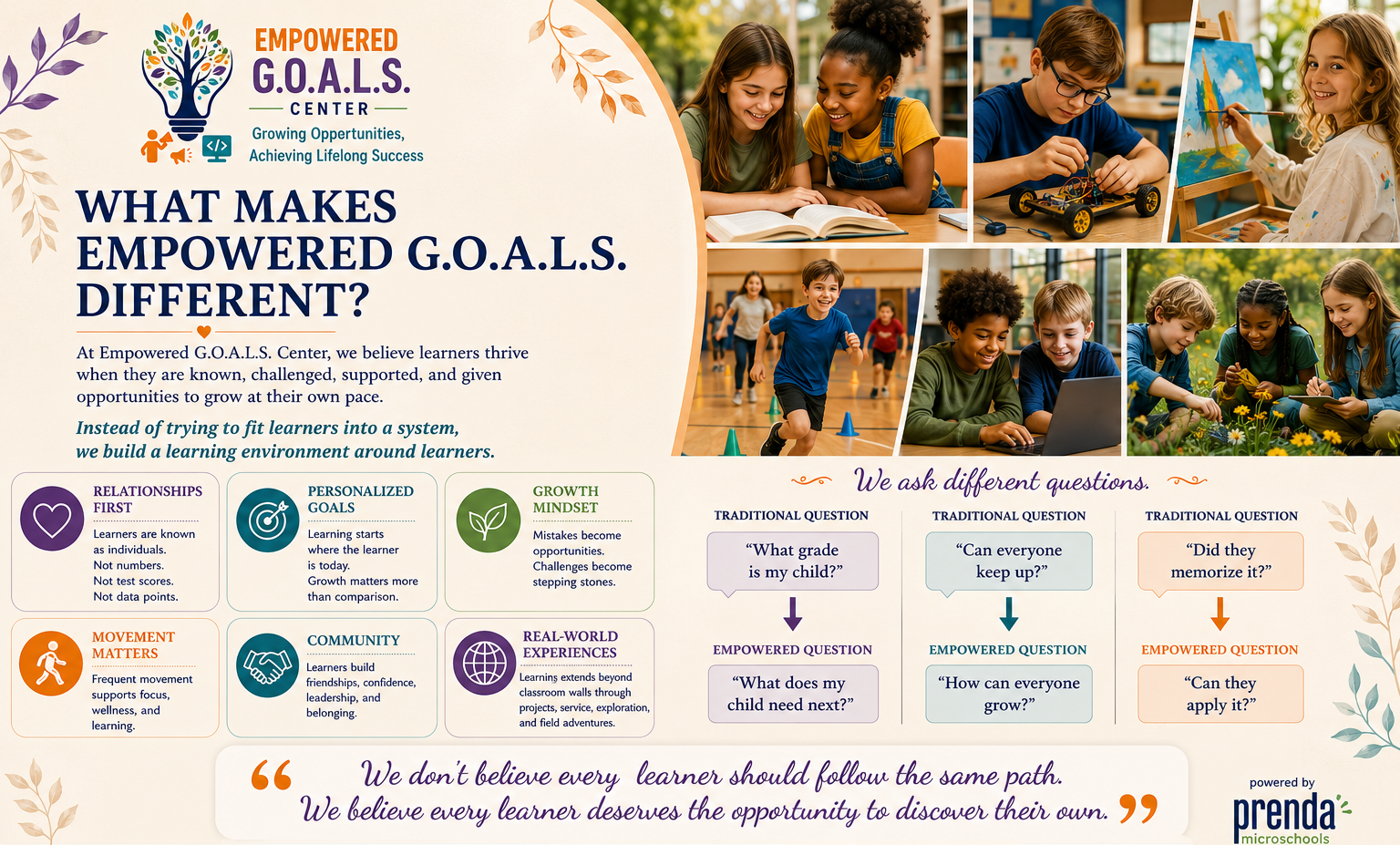
Children Don't All Learn the Same Way… Why Should They All Learn in the Same Place?
Children don't all learn the same way, so why should they all learn in the same place? Explore how personalized education, microschools, and learner-centered environments help gifted, high-potential, and twice-exceptional children thrive. Discover Empowered G.O.A.L.S. Center, serving families in the Clearwater and Largo, Florida area.
For generations, we've accepted the idea that children should learn together in the same place, following the same schedule, moving through the same curriculum at roughly the same pace.
For many learners, that model has worked well.
But as we've learned more about child development, neuroscience, giftedness, learning differences, and personalized education, an important question has emerged:
If children don't all learn the same way, why should they all learn in the same place?
The question isn't meant to diminish traditional schools. Every educational setting serves an important purpose, and incredible educators are making a difference every day.
Rather, it's an invitation to recognize something we know to be true:
Children are wonderfully unique.
Some learners thrive in a large classroom filled with energy and activity.
Others flourish in smaller learning communities where they are deeply known.
Some learn best through discussion.
Others need time to observe before they share their thinking.
Some discover their strengths through books.
Others discover them while building, creating, designing, exploring nature, or solving real-world problems.
None of these approaches are better than the others.
They're simply different.
Every Child Deserves an Environment Where They Can Flourish
As educators and parents, we often focus on how children learn.
Visual learners.
Hands-on learners.
Independent learners.
Collaborative learners.
Those differences matter.
But there's another question that's equally important:
Where does this child learn best?
The environment itself shapes learning.
A child who struggles in one setting may thrive in another.
A learner who seems disengaged may simply need more opportunities to move, create, ask questions, or work alongside peers who share similar interests.
Sometimes the environment—not the learner—is what needs to change.
Learning Is More Than Completing Assignments
Education is about much more than checking off standards or finishing worksheets.
Children are learning how to think.
How to collaborate.
How to solve problems.
How to persevere through challenges.
How to communicate ideas with confidence.
How to discover who they are.
The most meaningful learning often happens when children are actively engaged—asking questions, investigating ideas, creating projects, and connecting what they're learning to the world around them.
Those experiences don't replace academics.
They make academics meaningful.
There Isn't One Right Path
Families today have more educational choices than ever before.
Traditional public schools.
Charter schools.
Private schools.
Homeschooling.
Microschools.
Hybrid learning programs.
Each offers unique strengths because every child—and every family—is different.
The goal isn't to convince every family to choose the same path.
The goal is to help every family find the environment where their child can grow with confidence, curiosity, and joy.
Building Learning Communities
One of the things that excites me most about microschools is the opportunity to create learning communities where every child is truly known.
Small groups allow educators to recognize individual strengths, celebrate growth, and build meaningful relationships with learners and their families.
Children aren't simply another face in the classroom.
They become active participants in a community that values their ideas, encourages their curiosity, and supports their growth.
When learners feel known, they become more willing to take risks.
When they feel safe, they become more willing to ask questions.
When they feel valued, they begin to see themselves as capable.
And confidence has a remarkable way of opening doors to learning.
Looking Ahead
Education continues to evolve because our understanding of children continues to grow.
That's something worth celebrating.
My hope is that families feel empowered to explore the educational options available to them—not because one model is better than another, but because every child deserves an environment where they can flourish.
Children don't all learn the same way.
Perhaps they don't all need to learn in the same place, either.
And maybe that's one of the most exciting opportunities in education today.
About the Author
Karena Morrison is the founder of Empowered G.O.A.L.S. Center, a personalized microschool serving families in the Clearwater/Largo area. A Florida-certified educator with a master's degree in Gifted Studies, she has more than 25 years of homeschooling experience and is passionate about helping gifted, high-potential, and twice-exceptional learners discover confidence, curiosity, and a lifelong love of learning.