
This space is dedicated to thoughtful reflections and practical insights for families supporting gifted and twice-exceptional learners.
Here, we explore learning environments, literacy development, and growth-centered approaches designed to help gifted and twice-exceptional learners feel capable, confident, and supported.
New here?
If you’re exploring this space for the first time, our foundational post on multilevel learning offers a helpful place to begin.
👉 Why Multilevel Learning Works for Gifted and Twice-Exceptional Learners
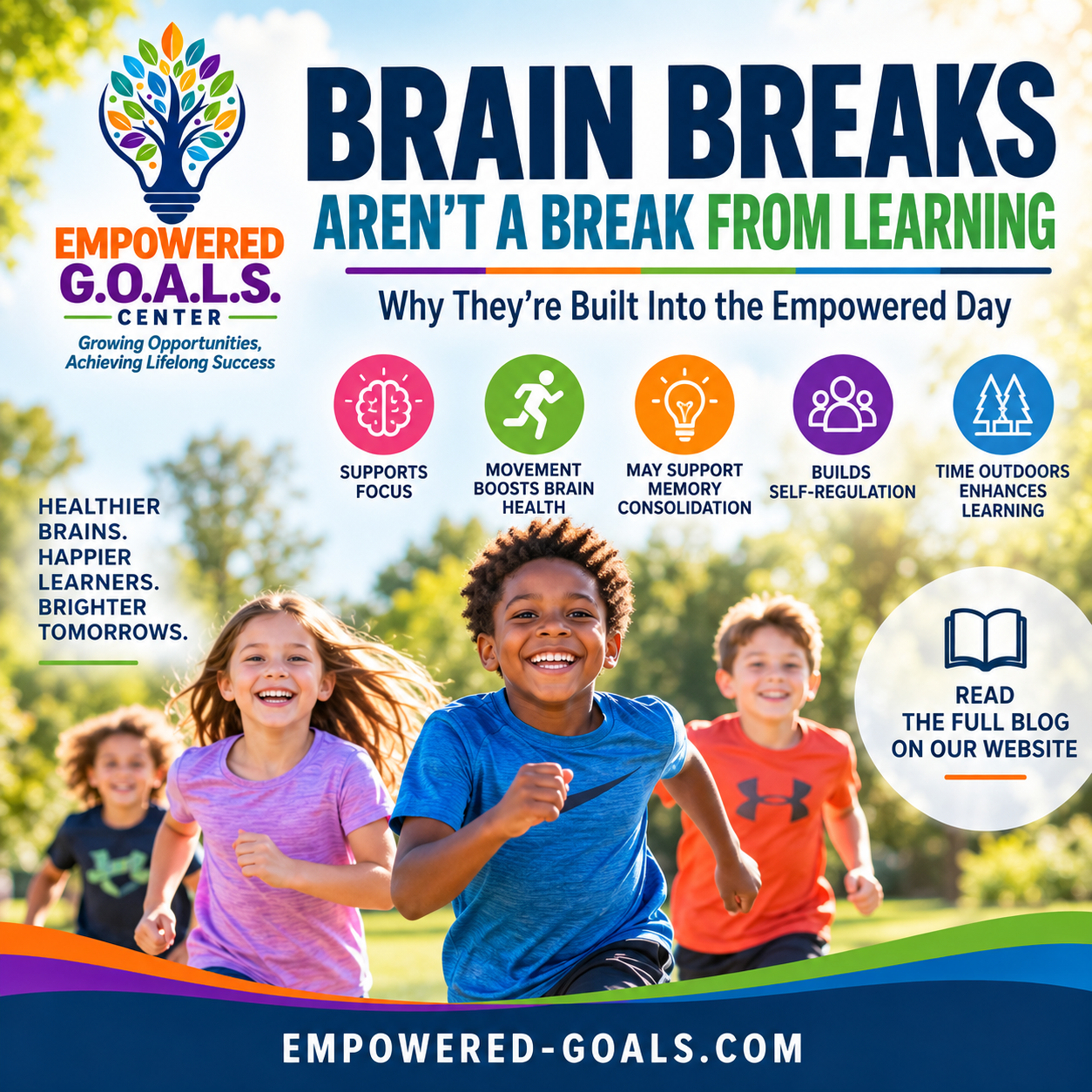
Brain Breaks Aren't a Break From Learning: Why They're Built Into the Empowered Day
Why are Brain Breaks intentionally built into every day at Empowered G.O.A.L.S. Center? Explore the research behind movement, memory consolidation, BDNF, self-regulation, and why short breaks between focused learning blocks may help children return ready to learn.
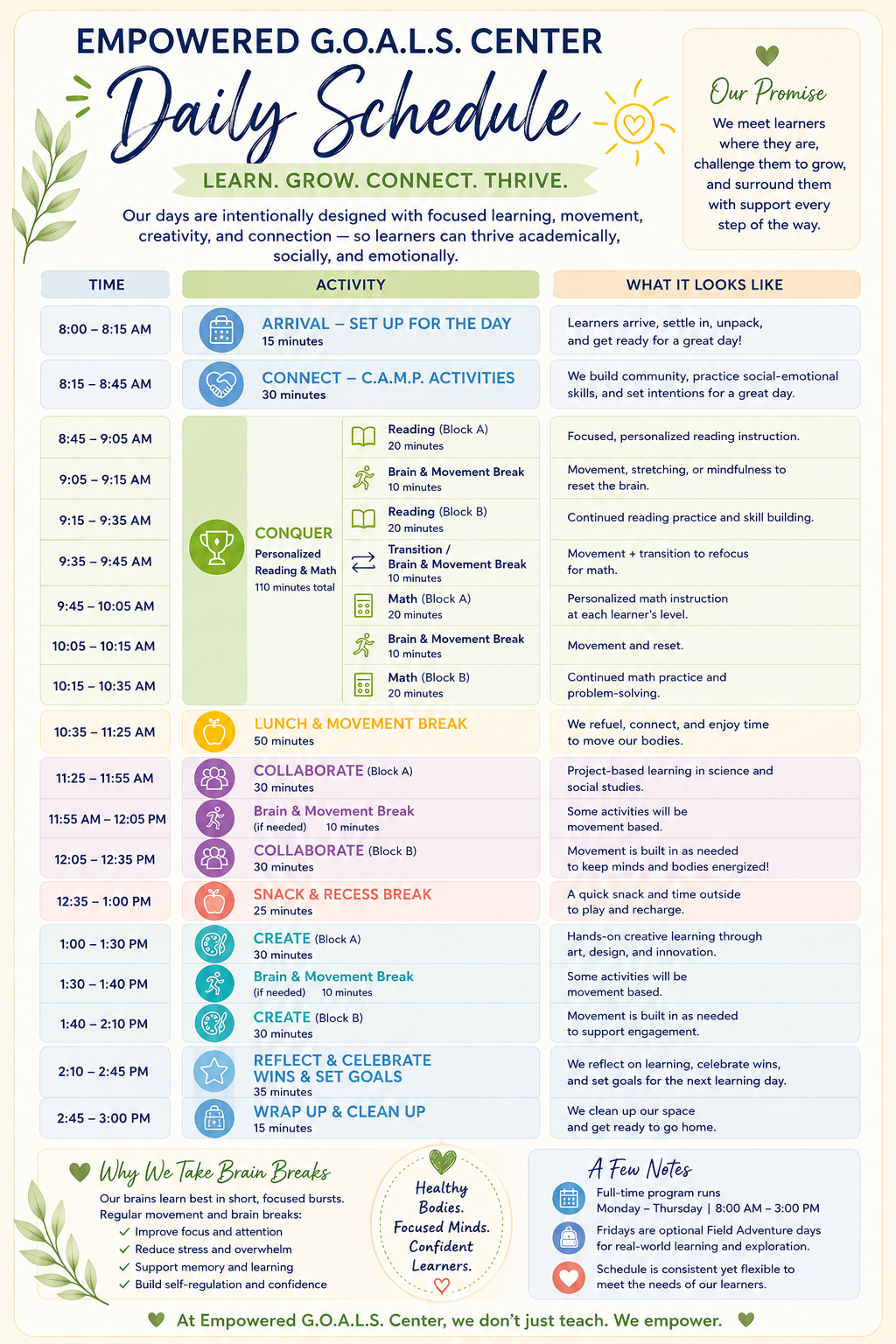
If you look at the daily schedule at Empowered G.O.A.L.S. Center, you'll notice something that I designed very intentionally:
Brain Breaks.
Lots of them. ❤️
Our learners aren't expected to sit through long stretches of Reading or Math simply because more minutes of instruction must mean more learning.
Instead, we use relatively short periods of focused academic work, followed by opportunities to step away, move, reset, and prepare for the next learning block.
Those breaks aren't something we squeeze into the schedule after the important learning has happened.
They're part of how I've designed the learning to happen.
And there is some fascinating science behind why….
More Instructional Time Doesn't Automatically Mean More Learning
It's easy to look at a ten-minute Brain Break and see ten minutes when a learner isn't doing Reading, Math, Science, STEAM, or Social Studies.
But learning doesn't work like a stopwatch.
Twenty additional minutes sitting in front of an academic task aren't necessarily more valuable than twenty highly focused minutes followed by an opportunity to reset.
Research examining active breaks during the school day has found particularly promising effects on children's classroom behavior and on-task engagement. A systematic review and meta-analysis of active-break interventions in primary schools found that every included study measuring time-on-task behavior reported significant improvement following active breaks (Masini et al., 2020).
Importantly, the researchers were much more cautious about academic achievement and cognitive functions such as attention, working memory, and executive functioning. Results in those areas were mixed, which is an important reminder that Brain Breaks aren't a magical shortcut to academic achievement (Masini et al., 2020).
Other research examining classroom-based physical activity has also found encouraging results while emphasizing that outcomes vary according to the type of activity, duration, and measures researchers use (Watson et al., 2017).
More recent research continues to explore this relationship. A 2026 meta-analysis of 25 randomized controlled trials found overall benefits of active breaks across several areas of executive functioning, including attention, inhibitory control, working memory, and cognitive flexibility. Exploratory findings suggested that breaks lasting approximately 5–15 minutes may be particularly promising, although that doesn't mean researchers have identified one perfect break length for every child (Li et al., 2026).
That's one reason Empowered's 10-minute Brain Breaks make so much sense to me.
Not because ten minutes is a magical number.
Because it provides enough time for a learner to actually step away from the academic demand and do something different before returning.
But Here's the Part I Find REALLY Fascinating: The Brain May Still Be Working
This is something I think we often miss when we talk about breaks.
When the lesson stops... learning doesn't necessarily stop with it.
Researchers studying memory have examined what happens during periods of wakeful rest after new information has been learned.
The brain doesn't necessarily file away new information instantaneously. Newly encoded memories can continue undergoing processes that help stabilize and consolidate them after active learning has ended. Research suggests that quiet periods of wakeful rest following learning may provide conditions that support this process (Wamsley, 2019).
A 2025 systematic review and meta-analysis examining research on wakeful rest and memory consolidation similarly found that brief periods of wakeful rest after learning were associated with better memory retention than immediately moving into another cognitively demanding activity (Weng et al., 2025).
In other words, the moment we stop actively teaching something isn't necessarily the moment the brain stops doing something with it.
I LOVE THAT. ❤️
Now, this is where it's important not to stretch the science beyond what researchers actually studied.
Much of the wakeful-rest research involves quiet rest, not playground activity, conversation, running outside, or the many other things an Empowered learner might choose to do during a Brain Break.
So I can't say:
“Ten minutes playing outside after Math causes today's lesson to consolidate into memory.”
The research doesn't establish that.
What it does challenge is a very common assumption:
If a learner isn't actively receiving instruction, nothing educational is happening.
The brain is much more interesting than that.
Sometimes giving newly learned information a little space before asking the brain to tackle the next cognitively demanding task may have value of its own.
Movement Changes What's Happening in the Brain, Too
Then there's another fascinating piece of the puzzle: BDNF.
Brain-derived neurotrophic factor, or BDNF, is a protein involved in neuroplasticity—the brain's ability to adapt and change. It plays important roles in learning, memory, and the development and maintenance of neural connections.
Researchers are studying the relationship between physical activity and BDNF in children.
A 2025 systematic review of randomized controlled trials involving children ages 5–12 found evidence suggesting that exercise may influence BDNF levels, while also emphasizing that the evidence in children remains limited. Only five studies involving 385 children met the researchers' criteria, and the results weren't uniform across the studies (Rico-González et al., 2025).
In other words, I'm not going to tell Empowered learners:
“Go run around for ten minutes and you'll release a magical brain chemical that makes you smarter.” 😂
That's not good neuroscience.
But BDNF gives us another fascinating glimpse into something much bigger:
The brain and the body aren't separate learning systems.
Physical activity can produce physiological changes associated with brain health and function.
And that matters when we're designing a school day for children.
So Why Do I Encourage Learners to GO OUTSIDE?
This is something I'm becoming even more intentional about.
Empowered learners have autonomy during their Brain Breaks.
I don't want to replace:
“Sit at your desk because I said so.”
with:
“Run outside because I said so.” 😂
That defeats part of the purpose.
However, I'm going to be talking with our learners more explicitly about why movement—preferably outside—is one of the strongest choices they can make during a Brain Break, particularly between demanding Reading and Math blocks.
Research examining children's experiences in natural environments has identified promising relationships with physical, mental, and social well-being. At the same time, researchers have cautioned that the evidence varies considerably in quality and methodology, so we shouldn't turn “go outside” into another oversimplified neuroscience claim (Mygind et al., 2019).
I don't need to tell learners that going outside is some kind of neurological prescription.
I can tell them something much more useful:
“Your brain has been working really hard. Moving your body and getting outside are two great ways you can choose to reset before your next learning block.”
And then I want them to notice what happens.
Because Ultimately, This Is About Learner Autonomy
This may be the most important part of Brain Breaks at Empowered.
I don't want our learners to simply become really good at following my schedule.
I want them to understand themselves.
What does it feel like when I'm losing focus?
How long can I work effectively before I need to reset?
Does movement help me?
Do I concentrate better after going outside?
Are there times when my body needs activity—but other times when my brain actually needs quiet?
What helps me return ready to learn?
Those are metacognitive and self-regulation skills.
And those skills matter far beyond a Reading or Math lesson.
One learner may discover that throwing a ball to a friend for ten minutes helps him return ready to tackle another academic challenge.
Another might want to walk.
Another might draw.
Another might need quiet.
And sometimes learners may discover that what they feel like choosing isn't actually what helps them return ready to learn. 😉
That's valuable information, too.
The goal isn't unrestricted free time.
The goal is gradually developing the ability to recognize:
“What does my brain need right now—and what choice will help me be successful when I come back?”
Focus. Break. Process. Reset. Return.
That's the rhythm I wanted when I designed Empowered.
Our learners engage in 20 minute blocks of focused academic work.
Then they step away.
They move.
They play.
They talk.
They think.
Sometimes they keep talking about what they were just learning.
Sometimes they appear to have completely forgotten about it. 😂
But their brains haven't simply switched OFF because the academic program isn't on the screen.
Then they return.
And we begin another period of focused learning.
Focus → Break → Process → Reset → Return.
That rhythm is intentional.
Brain Breaks Aren't Wasted Minutes
One of the assumptions I most want to challenge is the idea that educational rigor can be measured by how long we can keep children engaged in continuous academic instruction.
I don't measure the quality of an Empowered learning day by the number of consecutive minutes I can keep a learner sitting in a chair.
I care much more about the quality of the minutes when that learner is actually cognitively engaged.
Can they focus?
Can they persevere?
Can they recognize when their attention is slipping?
Can they use strategies to regulate themselves?
Can they return?
Can they eventually understand enough about their own brain to advocate for what helps them learn?
Because my goal isn't simply to teach children academics.
It's also to help them become learners who understand how they learn.
That's why Brain Breaks aren't something I reluctantly allow between the “real” parts of our school day.
Brain Breaks ARE part of the learning design at Empowered G.O.A.L.S. Center.
Because sometimes one of the most powerful things we can give a developing brain...
is a little space to do what brains do. ❤️
References
Li, C., Shangguan, Y., Zhong, Z., Zhou, R., Wang, H., & Li, D. (2026). Effects of active breaks on attention and executive function in children and adolescents: A meta-analysis. European Journal of Pediatrics, 185(9), 690.
Masini, A., Marini, S., Gori, D., Leoni, E., Rochira, A., & Dallolio, L. (2020). Evaluation of school-based interventions of active breaks in primary schools: A systematic review and meta-analysis. Journal of Science and Medicine in Sport, 23(4), 377–384.
Mygind, L., Kjeldsted, E., Hartmeyer, R., Mygind, E., Bølling, M., & Bentsen, P. (2019). Mental, physical and social health benefits of immersive nature-experience for children and adolescents: A systematic review and quality assessment of the evidence. Health & Place, 58, 102136.
Rico-González, M., González-Devesa, D., Gómez-Carmona, C. D., & Moreno-Villanueva, A. (2025). Exercise as modulator of brain-derived neurotrophic factor (BDNF) in children: A systematic review of randomized controlled trials. Life, 15(7), 1147.
Wamsley, E. J. (2019). Memory consolidation during waking rest. Trends in Cognitive Sciences, 23(3), 171–173.
Watson, A., Timperio, A., Brown, H., Best, K., & Hesketh, K. D. (2017). Effect of classroom-based physical activity interventions on academic and physical activity outcomes: A systematic review and meta-analysis. International Journal of Behavioral Nutrition and Physical Activity, 14, 114.
Weng, L., Yu, J., Lv, Z., Yang, S., Jülich, S. T., & Lei, X. (2025). Effects of wakeful rest on memory consolidation: A systematic review and meta-analysis. Psychonomic Bulletin & Review, 32(5), 1937–1968.
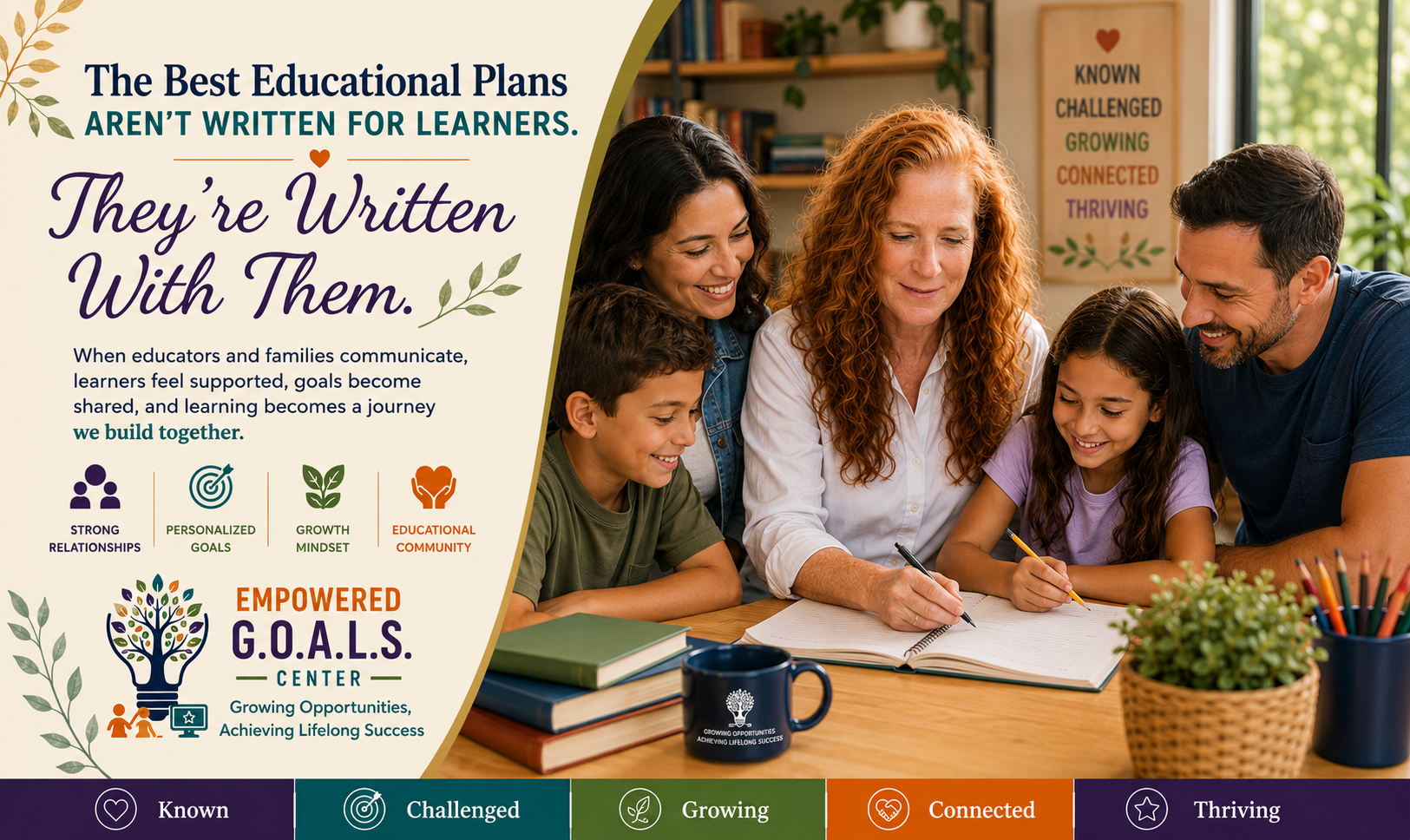
The Best Educational Plans Aren't Written for Learners. They're Written With Them.
The strongest educational plans begin with conversation. Discover why meaningful partnerships among learners, families, and educators create personalized goals, stronger relationships, and thriving educational communities.
One of the most meaningful questions an educator can ask isn't:
"How is this learner performing?"
It's:
"What does this learner need to grow?"
The answer rarely comes from a test score.
It comes from conversations.
It comes from relationships.
And it comes from building a genuine educational partnership between educators, learners, and families.
Every Learner Arrives with a Story
Long before a child walks into a classroom, they have already begun developing interests, strengths, challenges, dreams, and ways of understanding the world.
Parents have watched those moments unfold for years.
They know what excites their child.
They know what causes frustration.
They know what builds confidence—and what diminishes it.
Educators bring another important perspective.
They observe how learners interact with peers, approach challenges, solve problems, and respond to new opportunities.
Neither perspective is complete on its own.
Together, they create a fuller picture of the whole child.
Communication Builds Trust
When educators and families communicate regularly, something powerful happens.
Small concerns are addressed before they become larger ones.
Successes are celebrated together.
Goals become shared rather than separate.
Most importantly, learners begin to see that the important adults in their lives are working together—not independently.
That sense of consistency creates emotional safety.
And emotional safety creates room for learning.
Moving Beyond Report Cards
Traditional report cards rarely tell the entire story.
A grade cannot fully capture:
• Growing confidence
• Increased perseverance
• Stronger friendships
• Curiosity
• Leadership
• Creativity
• Resilience
• Problem-solving
These qualities matter.
In many ways, they are the foundation upon which lifelong learning is built.
That's why meaningful conversations between educators and families remain so important.
They allow us to celebrate growth that cannot be measured with numbers or letters.
Personalized Goals Begin with Listening
At Empowered G.O.A.L.S. Center, we believe educational goals should never be created in isolation.
Instead, they should emerge through thoughtful conversations that include three important voices:
The learner.
The family.
The educator.
Each brings valuable insight.
Learners often know what excites them, what challenges them, and what they hope to accomplish.
Families provide history, perspective, and dreams for the future.
Educators contribute experience, observation, and guidance.
When those perspectives come together, educational goals become deeply personal rather than simply procedural.
Learning becomes something we build together—not something we do to a child.
That's the heart of personalized education.
Building an Educational Community
One of the core beliefs that shapes Empowered G.O.A.L.S. Center is that education works best when it feels like a community.
Not a collection of separate people working independently.
A community.
In a strong educational community:
• Families are welcomed as partners.
• Learners feel heard and respected.
• Educators communicate openly and consistently.
• Everyone shares the same purpose: helping each learner continue growing.
That partnership creates something much bigger than academic success.
It creates belonging.
And children who know they belong become more willing to take risks, ask questions, persevere through challenges, and discover their own strengths.
Looking Ahead
Every learner deserves adults who believe in them.
Every family deserves to feel heard.
Every educator deserves the opportunity to build meaningful relationships with the learners they serve.
When we move beyond simply exchanging information and begin building authentic partnerships, education becomes something far more powerful.
It becomes a shared journey.
And perhaps that's one of the greatest gifts we can offer our children—not simply an education, but a community of people who believe in their potential and are committed to helping them grow.
About the Author
Karena Morrison is the founder of Empowered G.O.A.L.S. Center, a personalized microschool serving families in the Clearwater/Largo area. She is a Florida-certified educator in Exceptional Student Education (K–12) and Elementary Education (K–6), with endorsements in Reading and ESOL, and holds a master's degree in Curriculum & Instruction with a specialization in Gifted Studies. With more than 25 years of homeschooling experience, she believes the strongest educational communities are built through meaningful partnerships among learners, families, and educators.
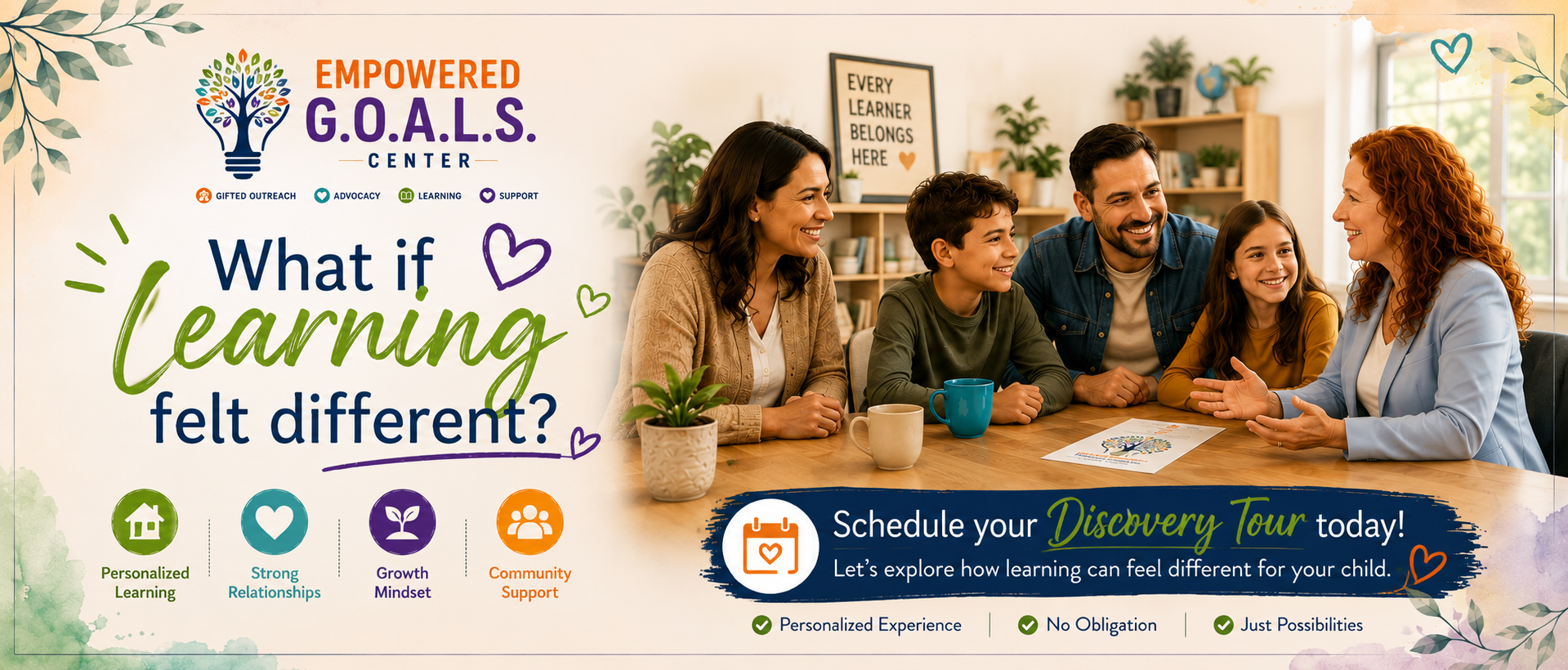
You Don’t Have to Do Homeschooling Alone
Homeschooling offers flexibility and freedom—but even strong, curious learners can hit roadblocks with reading, writing, or confidence. Empowered Hybrid was created to support homeschool families who want thoughtful, relationship-centered project-based instruction that meets learners where they are and helps them grow without pressure.
Homeschooling families often share a common story.
They didn't choose homeschooling because it was easy.
They chose it because it felt right for their learner.
Some were seeking flexibility.
Some were responding to burnout, anxiety, or unmet needs.
Some simply knew their child learned differently—and wanted an educational path that honored who they are.
After more than 25 years as a homeschooling parent, educator, and advocate for gifted and twice-exceptional learners, one truth has remained constant:
Homeschooling doesn't have to be a solo journey.
When You’re Doing Everything Right — and Still Wondering
Homeschooling parents invest incredible time, energy, and heart into their children's education.
They carefully select curriculum.
They adjust pacing.
They follow interests.
They celebrate strengths while supporting challenges.
And even then, questions naturally arise.
Am I providing enough opportunities for collaboration?
How can my child build friendships with other learners?
Would project-based learning help deepen their understanding?
How can I balance teaching at home while also meeting all of life's responsibilities?
These questions aren't signs that homeschooling isn't working.
They're signs of thoughtful parents who want the very best for their children.
Homeschooling Was Never Meant to Be a Solo Journey
One of the biggest misconceptions about homeschooling is that parents must do everything themselves.
In reality, many successful homeschooling families build a learning community around their children.
They seek opportunities for collaboration, enrichment, mentorship, field experiences, and friendships that complement learning at home.
Support doesn't replace homeschooling.
A Partnership Designed for Homeschool Families
That's why I created Empowered Pathways, our hybrid homeschool program at Empowered G.O.A.L.S. Center.
Families remain in charge of their learner's core academics at home while we partner together to provide meaningful opportunities for collaboration, creativity, and real-world learning.
Learners participate in:
Daily Connect community meetings
Collaborative Science and Social Studies experiences
Hands-on Create projects
Project-based learning
Meaningful peer interactions in small groups
Meanwhile, families continue guiding Reading and Math at home using the curriculum and pace that best meets their learner's needs.
It's homeschooling—with the added benefit of a supportive learning community.
Learning Is About More Than Academics
Children grow in many ways.
They develop confidence through collaboration.
Communication through shared experiences.
Leadership through meaningful responsibilities.
Creativity through authentic projects.
Friendships through spending time with peers who enjoy learning together.
These experiences are difficult to recreate alone, but they flourish within a small learning community where every learner is known and valued.
A Community That Grows Together
At Empowered G.O.A.L.S. Center, we believe children learn best when families and educators work together.
Our hybrid program isn't designed to replace homeschooling.
It's designed to support it.
Together, we create an environment where learners can continue growing academically while also developing confidence, curiosity, creativity, and meaningful connections.
An Invitation
If you're homeschooling and looking for opportunities to enrich your child's educational journey while remaining at the center of their learning, I'd love to connect with you.
Whether you're exploring hybrid education for the first time or simply looking for a community that shares your values, you're always welcome to learn more about Empowered Pathways at Empowered G.O.A.L.S. Center.
Because homeschooling doesn't have to happen alone—and sometimes the greatest growth happens when families learn together.
Why Multilevel Learning Works So Well for Gifted and Twice-Exceptional Learners
Many gifted and twice-exceptional learners don’t struggle because they lack ability — they struggle because the learning environment doesn’t match how they think. This post explores why multilevel learning offers a more supportive, flexible path for growth.
Start here
Families of gifted and twice-exceptional learners often come to us asking the same question:
“Why does school feel so hard when my child is clearly capable?”
For many of these learners, the problem isn’t ability — it’s environment.
Traditional classrooms are built around age-based pacing, standardized benchmarks, and whole-group instruction. While that model works for some learners, it often misses the mark for children who learn asynchronously, think deeply, or need both challenge and support at the same time.
That’s where multilevel learning shines.
Long before it became a “buzzword,” multilevel instruction was the foundation of the one-room schoolhouse — and today, modern research and experience continue to affirm what families of gifted and 2e learners already know instinctively:
learning doesn’t happen in neat, grade-level boxes.
1. Gifted Learners Thrive Through Peer Modeling and Mentorship
In multilevel learning environments, learners are exposed to a wider range of thinking, language, and problem-solving approaches.
Younger or less experienced learners naturally stretch upward.
More advanced learners deepen their understanding by explaining, modeling, and mentoring.
For gifted and twice-exceptional learners, this creates something rare:
Intellectual stimulation without pressure
Leadership opportunities without competition
Confidence rooted in contribution, not comparison
Instead of being told to “wait,” learners are invited to engage — at their own level, in their own way.
2. Independence and Self-Advocacy Are Built In
Many gifted and twice-exceptional learners struggle in environments where adults constantly direct, pace, and monitor every step. In contrast, multilevel settings gently teach learners how to manage themselves.
They learn how to:
Work independently
Persist through challenge
Ask for help when needed
Recognize their own growth
These skills are especially powerful for twice-exceptional learners who may have strong reasoning abilities but need explicit support developing executive functioning and confidence.
3. Instruction Is Personalized — Not Pushed
In multilevel instruction, personalization isn’t an “extra.” It’s the expectation.
Learners move forward when they are ready — not when the calendar says it’s time. That flexibility is critical for gifted and 2e learners whose academic profiles are often uneven.
At Empowered G.O.A.L.S. Center’s Literacy Lab, this looks like:
Small-group, structured literacy instruction
Targeted support for foundational skills without stigma
Purposeful enrichment for advanced readers
Explicit, confidence-building teaching aligned to each learner’s profile
Instruction is delivered in small, joyful learning communities, allowing learners to grow academically while rebuilding trust in themselves as capable readers.
4. Community Replaces Comparison
Multilevel learning naturally reduces the unhealthy comparison that often fuels anxiety and perfectionism in gifted learners.
Instead of asking, “Am I ahead or behind?”
Learners begin asking, “What am I working on next?”
Older learners model perseverance.
Younger learners see what’s possible.
Everyone belongs.
This sense of belonging is especially meaningful for twice-exceptional learners who may feel out of place in traditional classrooms.
5. Learning Reflects Real Life
Outside of school, we don’t separate people by age or ability — we collaborate, problem-solve, and grow together.
Multilevel learning mirrors that reality.
It prepares learners to:
Work with diverse peers
Adapt to different expectations
Lead with empathy
Learn continuously
For gifted and twice-exceptional learners, this approach honors both their intellectual strengths and their human needs.
The Bigger Picture
Multilevel learning isn’t a step backward — it’s a thoughtful step forward.
At Empowered G.O.A.L.S. Center, our Literacy Lab serves as an intentional entry point for families who are seeking something different:
a learning experience where gifted and twice-exceptional learners are seen, supported, and challenged — without pressure to fit a mold.
For many families, Literacy Lab becomes the beginning of a deeper journey toward learning environments that prioritize:
Growth mindset
Emotional safety
Confidence
Curiosity
And a lifelong love of learning
Sometimes, the most innovative solutions are rooted in what has always worked.
This post is part of an ongoing series exploring supportive learning options for gifted and twice-exceptional learners.