
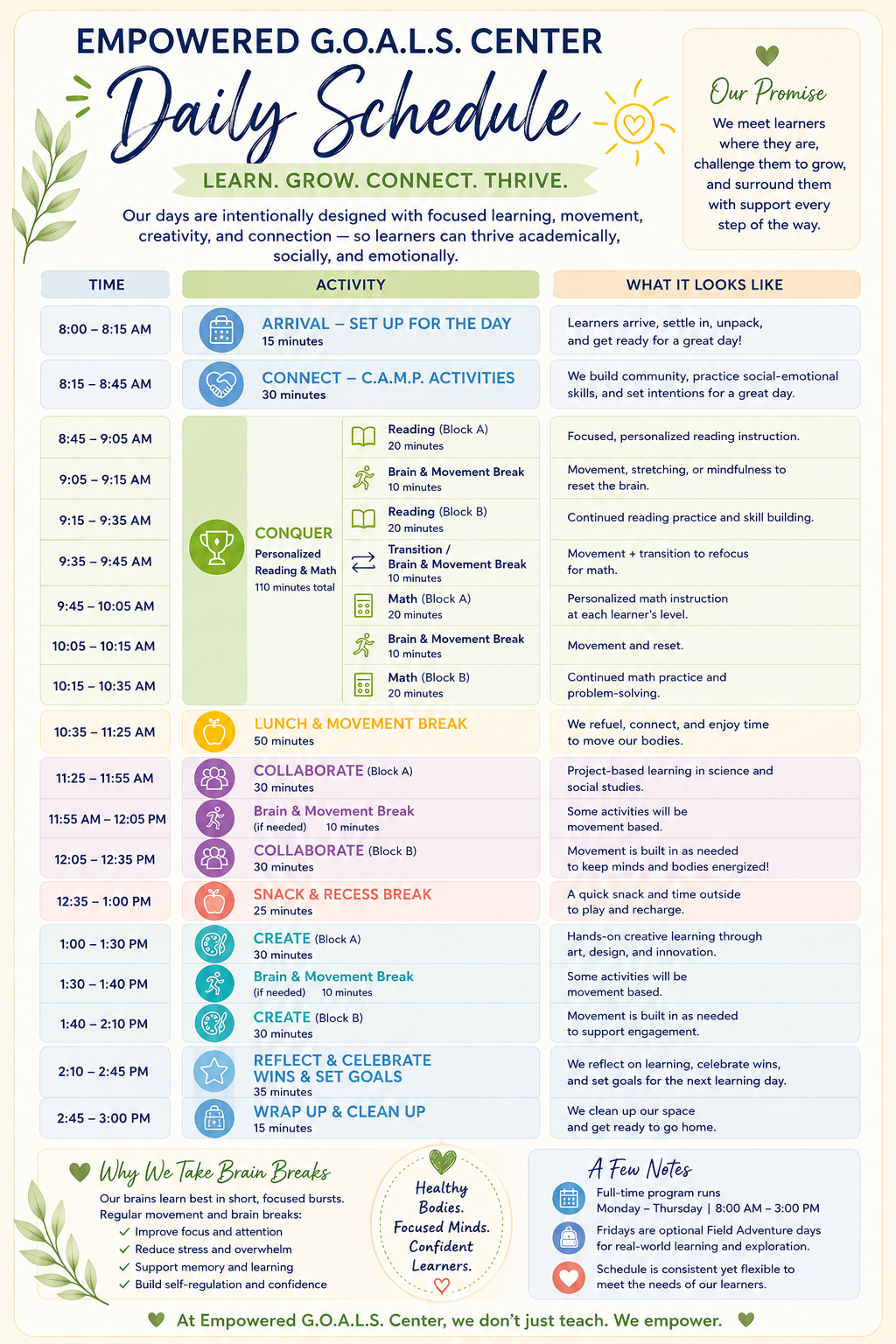
If you look at the daily schedule at Empowered G.O.A.L.S. Center, you'll notice something that I designed very intentionally:
Brain Breaks.
Lots of them. ❤️
Our learners aren't expected to sit through long stretches of Reading or Math simply because more minutes of instruction must mean more learning.
Instead, we use relatively short periods of focused academic work, followed by opportunities to step away, move, reset, and prepare for the next learning block.
Those breaks aren't something we squeeze into the schedule after the important learning has happened.
They're part of how I've designed the learning to happen.
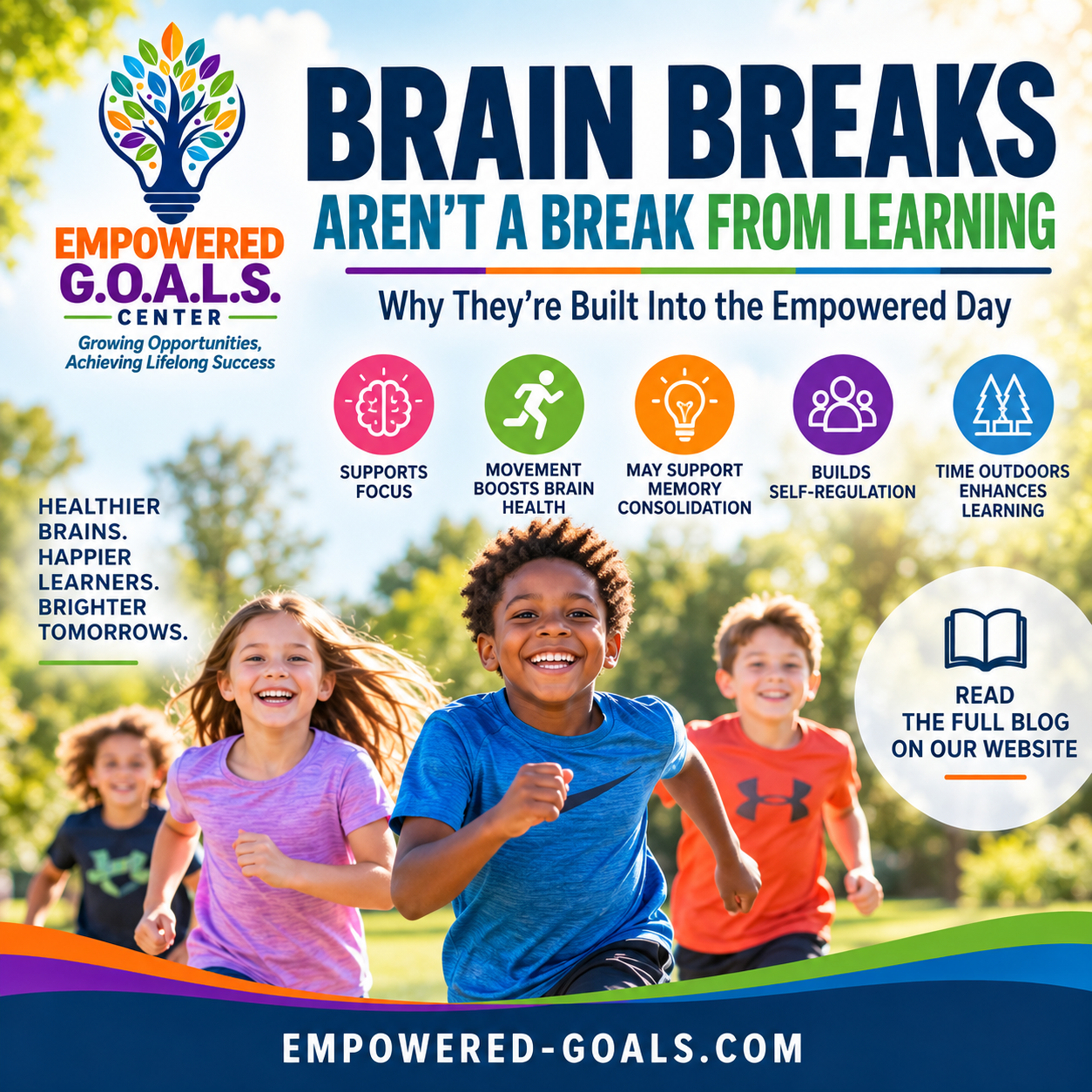
And there is some fascinating science behind why….
More Instructional Time Doesn't Automatically Mean More Learning
It's easy to look at a ten-minute Brain Break and see ten minutes when a learner isn't doing Reading, Math, Science, STEAM, or Social Studies.
But learning doesn't work like a stopwatch.
Twenty additional minutes sitting in front of an academic task aren't necessarily more valuable than twenty highly focused minutes followed by an opportunity to reset.
Research examining active breaks during the school day has found particularly promising effects on children's classroom behavior and on-task engagement. A systematic review and meta-analysis of active-break interventions in primary schools found that every included study measuring time-on-task behavior reported significant improvement following active breaks (Masini et al., 2020).
Importantly, the researchers were much more cautious about academic achievement and cognitive functions such as attention, working memory, and executive functioning. Results in those areas were mixed, which is an important reminder that Brain Breaks aren't a magical shortcut to academic achievement (Masini et al., 2020).
Other research examining classroom-based physical activity has also found encouraging results while emphasizing that outcomes vary according to the type of activity, duration, and measures researchers use (Watson et al., 2017).
More recent research continues to explore this relationship. A 2026 meta-analysis of 25 randomized controlled trials found overall benefits of active breaks across several areas of executive functioning, including attention, inhibitory control, working memory, and cognitive flexibility. Exploratory findings suggested that breaks lasting approximately 5–15 minutes may be particularly promising, although that doesn't mean researchers have identified one perfect break length for every child (Li et al., 2026).
That's one reason Empowered's 10-minute Brain Breaks make so much sense to me.
Not because ten minutes is a magical number.
Because it provides enough time for a learner to actually step away from the academic demand and do something different before returning.
But Here's the Part I Find REALLY Fascinating: The Brain May Still Be Working
This is something I think we often miss when we talk about breaks.
When the lesson stops... learning doesn't necessarily stop with it.
Researchers studying memory have examined what happens during periods of wakeful rest after new information has been learned.
The brain doesn't necessarily file away new information instantaneously. Newly encoded memories can continue undergoing processes that help stabilize and consolidate them after active learning has ended. Research suggests that quiet periods of wakeful rest following learning may provide conditions that support this process (Wamsley, 2019).
A 2025 systematic review and meta-analysis examining research on wakeful rest and memory consolidation similarly found that brief periods of wakeful rest after learning were associated with better memory retention than immediately moving into another cognitively demanding activity (Weng et al., 2025).
In other words, the moment we stop actively teaching something isn't necessarily the moment the brain stops doing something with it.
I LOVE THAT. ❤️
Now, this is where it's important not to stretch the science beyond what researchers actually studied.
Much of the wakeful-rest research involves quiet rest, not playground activity, conversation, running outside, or the many other things an Empowered learner might choose to do during a Brain Break.
So I can't say:
“Ten minutes playing outside after Math causes today's lesson to consolidate into memory.”
The research doesn't establish that.
What it does challenge is a very common assumption:
If a learner isn't actively receiving instruction, nothing educational is happening.
The brain is much more interesting than that.
Sometimes giving newly learned information a little space before asking the brain to tackle the next cognitively demanding task may have value of its own.
Movement Changes What's Happening in the Brain, Too
Then there's another fascinating piece of the puzzle: BDNF.
Brain-derived neurotrophic factor, or BDNF, is a protein involved in neuroplasticity—the brain's ability to adapt and change. It plays important roles in learning, memory, and the development and maintenance of neural connections.
Researchers are studying the relationship between physical activity and BDNF in children.
A 2025 systematic review of randomized controlled trials involving children ages 5–12 found evidence suggesting that exercise may influence BDNF levels, while also emphasizing that the evidence in children remains limited. Only five studies involving 385 children met the researchers' criteria, and the results weren't uniform across the studies (Rico-González et al., 2025).
In other words, I'm not going to tell Empowered learners:
“Go run around for ten minutes and you'll release a magical brain chemical that makes you smarter.” 😂
That's not good neuroscience.
But BDNF gives us another fascinating glimpse into something much bigger:
The brain and the body aren't separate learning systems.
Physical activity can produce physiological changes associated with brain health and function.
And that matters when we're designing a school day for children.
So Why Do I Encourage Learners to GO OUTSIDE?
This is something I'm becoming even more intentional about.
Empowered learners have autonomy during their Brain Breaks.
I don't want to replace:
“Sit at your desk because I said so.”
with:
“Run outside because I said so.” 😂
That defeats part of the purpose.
However, I'm going to be talking with our learners more explicitly about why movement—preferably outside—is one of the strongest choices they can make during a Brain Break, particularly between demanding Reading and Math blocks.
Research examining children's experiences in natural environments has identified promising relationships with physical, mental, and social well-being. At the same time, researchers have cautioned that the evidence varies considerably in quality and methodology, so we shouldn't turn “go outside” into another oversimplified neuroscience claim (Mygind et al., 2019).
I don't need to tell learners that going outside is some kind of neurological prescription.
I can tell them something much more useful:
“Your brain has been working really hard. Moving your body and getting outside are two great ways you can choose to reset before your next learning block.”
And then I want them to notice what happens.
Because Ultimately, This Is About Learner Autonomy
This may be the most important part of Brain Breaks at Empowered.
I don't want our learners to simply become really good at following my schedule.
I want them to understand themselves.
What does it feel like when I'm losing focus?
How long can I work effectively before I need to reset?
Does movement help me?
Do I concentrate better after going outside?
Are there times when my body needs activity—but other times when my brain actually needs quiet?
What helps me return ready to learn?
Those are metacognitive and self-regulation skills.
And those skills matter far beyond a Reading or Math lesson.
One learner may discover that throwing a ball to a friend for ten minutes helps him return ready to tackle another academic challenge.
Another might want to walk.
Another might draw.
Another might need quiet.
And sometimes learners may discover that what they feel like choosing isn't actually what helps them return ready to learn. 😉
That's valuable information, too.
The goal isn't unrestricted free time.
The goal is gradually developing the ability to recognize:
“What does my brain need right now—and what choice will help me be successful when I come back?”
Focus. Break. Process. Reset. Return.
That's the rhythm I wanted when I designed Empowered.
Our learners engage in 20 minute blocks of focused academic work.
Then they step away.
They move.
They play.
They talk.
They think.
Sometimes they keep talking about what they were just learning.
Sometimes they appear to have completely forgotten about it. 😂
But their brains haven't simply switched OFF because the academic program isn't on the screen.
Then they return.
And we begin another period of focused learning.
Focus → Break → Process → Reset → Return.
That rhythm is intentional.
Brain Breaks Aren't Wasted Minutes
One of the assumptions I most want to challenge is the idea that educational rigor can be measured by how long we can keep children engaged in continuous academic instruction.
I don't measure the quality of an Empowered learning day by the number of consecutive minutes I can keep a learner sitting in a chair.
I care much more about the quality of the minutes when that learner is actually cognitively engaged.
Can they focus?
Can they persevere?
Can they recognize when their attention is slipping?
Can they use strategies to regulate themselves?
Can they return?
Can they eventually understand enough about their own brain to advocate for what helps them learn?
Because my goal isn't simply to teach children academics.
It's also to help them become learners who understand how they learn.
That's why Brain Breaks aren't something I reluctantly allow between the “real” parts of our school day.
Brain Breaks ARE part of the learning design at Empowered G.O.A.L.S. Center.
Because sometimes one of the most powerful things we can give a developing brain...
is a little space to do what brains do. ❤️
References
Li, C., Shangguan, Y., Zhong, Z., Zhou, R., Wang, H., & Li, D. (2026). Effects of active breaks on attention and executive function in children and adolescents: A meta-analysis. European Journal of Pediatrics, 185(9), 690.
Masini, A., Marini, S., Gori, D., Leoni, E., Rochira, A., & Dallolio, L. (2020). Evaluation of school-based interventions of active breaks in primary schools: A systematic review and meta-analysis. Journal of Science and Medicine in Sport, 23(4), 377–384.
Mygind, L., Kjeldsted, E., Hartmeyer, R., Mygind, E., Bølling, M., & Bentsen, P. (2019). Mental, physical and social health benefits of immersive nature-experience for children and adolescents: A systematic review and quality assessment of the evidence. Health & Place, 58, 102136.
Rico-González, M., González-Devesa, D., Gómez-Carmona, C. D., & Moreno-Villanueva, A. (2025). Exercise as modulator of brain-derived neurotrophic factor (BDNF) in children: A systematic review of randomized controlled trials. Life, 15(7), 1147.
Wamsley, E. J. (2019). Memory consolidation during waking rest. Trends in Cognitive Sciences, 23(3), 171–173.
Watson, A., Timperio, A., Brown, H., Best, K., & Hesketh, K. D. (2017). Effect of classroom-based physical activity interventions on academic and physical activity outcomes: A systematic review and meta-analysis. International Journal of Behavioral Nutrition and Physical Activity, 14, 114.
Weng, L., Yu, J., Lv, Z., Yang, S., Jülich, S. T., & Lei, X. (2025). Effects of wakeful rest on memory consolidation: A systematic review and meta-analysis. Psychonomic Bulletin & Review, 32(5), 1937–1968.